AI Jewelry Generator Rings, necklaces, earrings and bracelets in 3D
Free. Use your own Anthropic or OpenAI key.
Also from Innerscene: Circadian Lab, a free lighting calculator for room illuminance, melanopic EML, and glare.
Watch how it works
A ring made for your stone, from its grading report
Add a photo or screenshot of the stone's grading report (GIA, IGI, HRD or AGS) with your request. The AI reads the measurements, table, depth, crown and pavilion angles and girdle, builds that exact stone, and sizes the head, claws and seat around it. It places the stone so its culet clears the finger, then checks the carat weight of the model against the report.
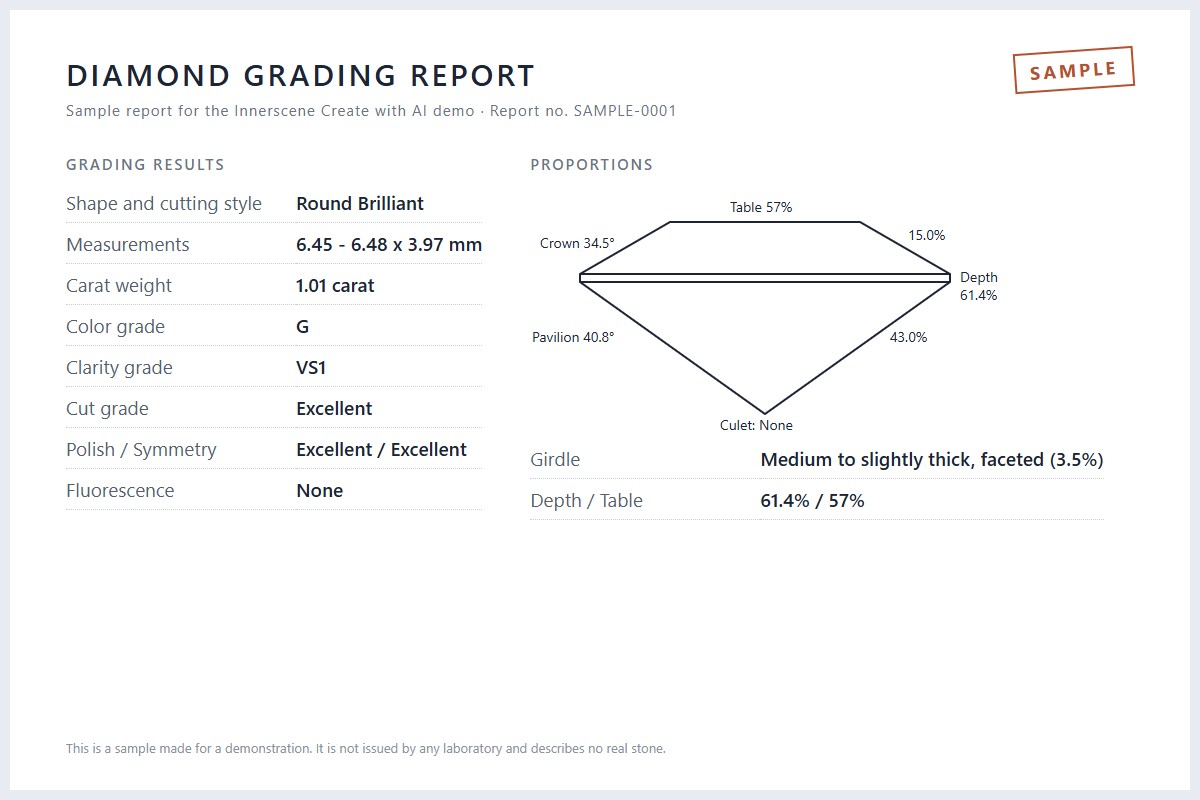
The sample report is made up for this demo and describes no real stone. In the video above, the AI builds the ring from it, then changes the band to yellow gold with pavé shoulders.
How it works
- 1. Describe it or add a photoType what you want in plain words, with sizes if you know them, or add a photo as a reference. Describe an object or a person.
- 2. The AI builds and checks itThe AI writes an OpenSCAD program for an object, or sets up the character generator for a person. It looks at six rendered views of the result and fixes what is wrong, up to five builds per message.
- 3. Refine and exportThe model opens in the viewer at real size. Ask for changes in the chat, move the sliders, then download it or pick a format from the Export menu.
Why make it with AI here
- Ring sizes, band widths and stone sizes follow jewelry conventions, so the piece is the size you asked for.
- Stones sit in seats cut into the metal, with prongs and beads that touch the girdle, ready for a CAD jeweler to finish.
- Each build reports the metal weight and the total carats, useful for a first quote.
What the jewelry toolkit does
- Stones from grading reports
- Measurements, table %, depth %, crown and pavilion angles and girdle thickness set the stone's real proportions. The weight of the model's stone is checked against the report's carat weight.
- Ring sizes
- US and Canadian sizes, UK letters, European sizes or an inside diameter in millimetres, converted exactly. US size 6 is 16.5 mm inside.
- Prong heads and bezels
- Four- and six-prong baskets with gallery rails, claws that lean over the crown, and bezel cups with a lip. The head's height follows the stone's pavilion depth, so the culet clears the finger.
- Seats and pavé
- Every stone sits in a seat cut into the metal. Pavé follows shanks, halos and curved surfaces, with shared beads that touch each girdle, and milgrain finishes the edges.
- Shanks
- Comfort-fit, D-shape, flat, knife-edge and round profiles, tapered toward the head, plain or split into two strands.
- Cuts and gems
- Brilliant cuts (round with its 57 facets, oval, princess, cushion, pear, marquise, radiant, trillion, heart), step cuts (emerald, asscher, baguette), cabochons, rose cuts and briolettes, in diamond, ruby, sapphire, emerald, amethyst, aquamarine, moissanite or pearl.
- Chains
- Cable, curb, Cuban, figaro, rope, box, snake, paperclip, ball and wheat chains with interlocking links, lobster, spring-ring, toggle or box clasps, and their length, link count and weight in the report.
- Tennis lines and pearls
- Tennis bracelets, necklaces and hoops with each stone in its own box setting, hinged together. Pearl strands with knots between the pearls, graduated or even, with a clasp.
- Earrings and findings
- Hinged hoops and huggies, stud posts with butterfly or screw backs, fish-hook and lever-back ear wires, bails, jump rings and signet ring faces ready for engraving.
- Display forms
- A velvet bust that a necklace drapes on at its real length, a display ear and an earring card, alongside the display hand for rings and bracelets.
- Metal weight and carats
- Each build reports the metal weight in 18k and 14k gold, Pt950 platinum or sterling silver, with the stone count and total carats.
- Close-up checks
- Before it finishes, the AI looks at close-up renders of every setting: claws on the crown, beads on the girdles, no stone floating or sunk too deep.
- Engraving
- Inscriptions inside or outside a band, in script, serif or blackletter fonts, engraved or filled with a contrasting finish.
Prompts to try
Click one to open it in the AI panel, then change the sizes to suit.
Getting the piece to casting or CAD
- Open the Export menu above the viewer.
- Choose STL or 3MF for resin printing and casting, or Rhino 3DM or STEP to finish it in jewelry CAD.
- Choose GLB to show the design with its metals and stones on a website or in AR.
Sizes are in millimetres. Stones are separate solids, so you can leave them out when you print the metal.
Best export formats: STL, 3MF, Rhino 3DM, GLB
Good to know
It is a design and quoting tool. Have your caster check wall thicknesses and prong sizes before production, and expect a jeweler to refine very fine work such as filigree.
Cost and privacy
You use your own Anthropic or OpenAI API key. It is stored only in your browser and sent only to that provider, which bills you directly: a model typically costs $0.05 to $0.30 at Standard quality and up to about $1 at Detailed, and Innerscene charges nothing. Your key and prompts are not sent to Innerscene; we record anonymous usage statistics such as the steps used, the model chosen, token counts, a cost estimate and whether a model was made.