Product Comparison: Sky Factory vs Innerscene Circadian Sky
Side-by-side comparison of specific products. The Sky Factory IRIS IR-26-RVN (2′×6′, 85W) is shown as the closest power-class match to Innerscene Circadian Sky 2′×4′ (75W). Sky Factory specifications are sourced from their published technical data sheets (dated October 2025). “Not published” indicates the specification was not found in the publicly available documentation reviewed.
Product type
EcoPlus EP24
IRIS IR-26-RVN
Innerscene Circadian Sky
Fixture size
EcoPlus EP24
IRIS IR-26-RVN
Innerscene Circadian Sky
Intended use
EcoPlus EP24
IRIS IR-26-RVN
Innerscene Circadian Sky
CCT range
EcoPlus EP24
IRIS IR-26-RVN
Innerscene Circadian Sky
Delivered lumens
EcoPlus EP24
IRIS IR-26-RVN
Innerscene Circadian Sky
Power consumption
Efficacy (lm/W)
EcoPlus EP24
IRIS IR-26-RVN
Innerscene Circadian Sky
CRI
EcoPlus EP24
IRIS IR-26-RVN
Innerscene Circadian Sky
R9 (deep red rendering)
EcoPlus EP24
IRIS IR-26-RVN
Innerscene Circadian Sky
Duv (color accuracy)
EcoPlus EP24
IRIS IR-26-RVN
Innerscene Circadian Sky
MacAdam Ellipse (SDCM)
EcoPlus EP24
IRIS IR-26-RVN
Innerscene Circadian Sky
TM-30 data published?
EcoPlus EP24
IRIS IR-26-RVN
Innerscene Circadian Sky
IES / photometric files available?
EcoPlus EP24
IRIS IR-26-RVN
Innerscene Circadian Sky
Fixture depth
Min. plenum clearance
EcoPlus EP24
IRIS IR-26-RVN
Innerscene Circadian Sky
Weight
EcoPlus EP24
IRIS IR-26-RVN
Innerscene Circadian Sky
Power supply
EcoPlus EP24
IRIS IR-26-RVN
Innerscene Circadian Sky
LED lifespan
LED chip architecture
EcoPlus EP24
IRIS IR-26-RVN
Innerscene Circadian Sky
Circadian scheduling
EcoPlus EP24
IRIS IR-26-RVN
Innerscene Circadian Sky
Real sky color tracking
EcoPlus EP24
IRIS IR-26-RVN
Innerscene Circadian Sky
Wireless fixture-to-fixture sync
EcoPlus EP24
IRIS IR-26-RVN
Innerscene Circadian Sky
Control protocols
EcoPlus EP24
IRIS IR-26-RVN
Innerscene Circadian Sky
Flicker-free dimming
EcoPlus EP24
IRIS IR-26-RVN
Innerscene Circadian Sky
Optical depth cues (parallax, stereopsis, accommodation)
EcoPlus EP24
IRIS IR-26-RVN
Innerscene Circadian Sky
Safety certifications
EcoPlus EP24
IRIS IR-26-RVN
Innerscene Circadian Sky
Sky Factory specifications sourced from published technical data sheets: TSF_TechSpecs_IRIS_RVN_CE (10.25.2025), TSF_TechSpecs_Clssc_EP24 (4.28.2022), and skyfactory.com/skyceiling-lighting-options. Innerscene specifications from published spec sheets and photometric reports. This comparison is provided for informational purposes; verify all specifications with the respective manufacturer before specifying.
Why CCT Range Matters
Sky Factory's standard EcoPlus products are fixed at 6,500K. Their IRIS system adds a sunrise-to-sunset color shift, but the actual CCT range is not published. Circadian Sky covers 2,200K to 40,000K — from warm candlelight to deep blue zenith sky — with every CCT individually calibrated on the blackbody or daylight locus.
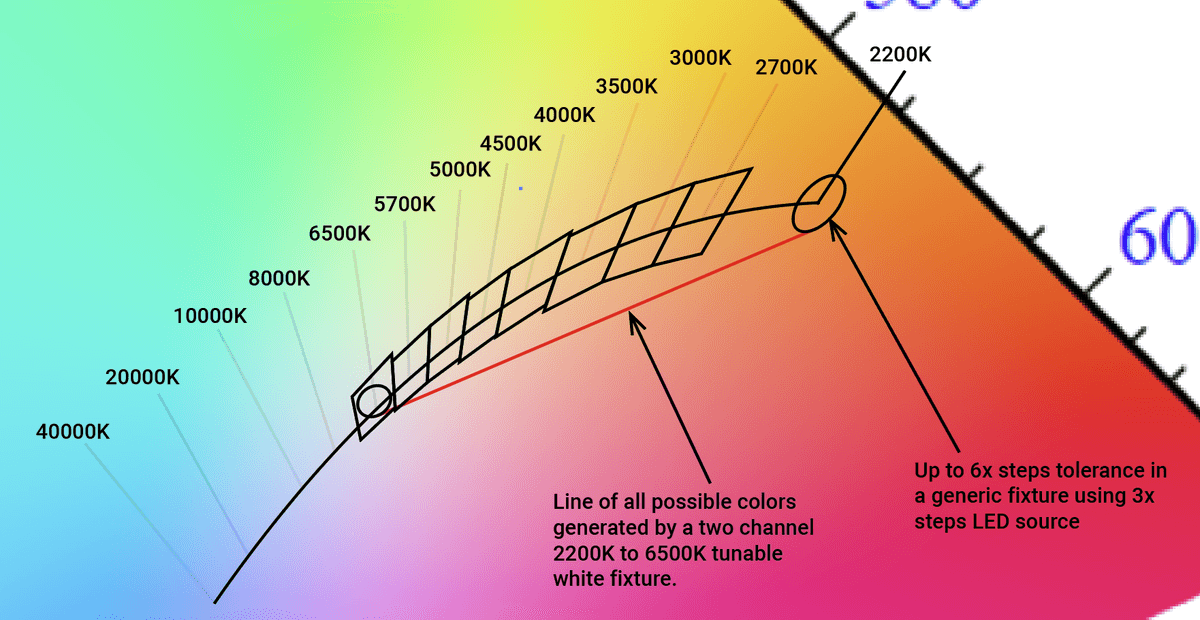
The image shows Circadian Sky's measured color points across the full CCT range, tracking the natural daylight curve. Two-chip tunable white systems (red line) produce colors along a straight line that misses the natural curve, creating unnatural tints at intermediate settings.
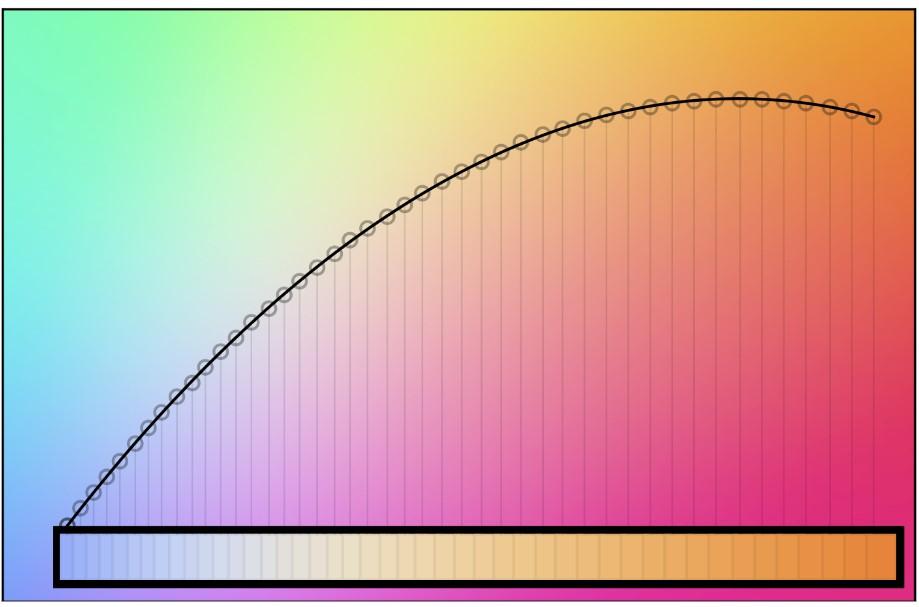
Circadian Sky measured color points (circles) plotted on a CIE 1931 chromaticity diagram, tracking the blackbody and daylight locus curves from 2,200K to 40,000K. The bar at the bottom shows the corresponding visible color at each CCT.
The Problem with Single-Channel (1-Chip) White
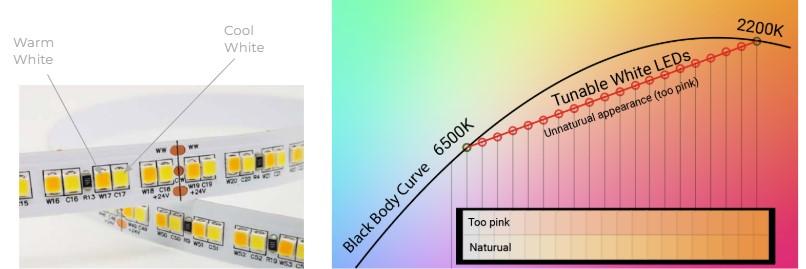
The most common LED image panels — including Sky Factory's EcoPlus line — use a single fixed-CCT white LED (typically 6,500K). While simple and affordable, this approach has fundamental limitations for any space where occupants spend extended time:
- Static, monotonous environment: The light never changes. Real daylight shifts continuously from warm sunrise through cool midday to warm sunset. A fixed-CCT ceiling creates an unchanging visual environment that can feel claustrophobic and artificial over hours.
- No circadian support: Fixed 6,500K provides no morning-to-evening variation. Without CCT changes, the lighting cannot support natural circadian rhythms — missing the warmer tones that signal evening wind-down and the cooler, high-melanopic light that supports daytime alertness.
- Cannot reach sky-blue CCTs: While the printed image panel may depict a blue sky, the light emitted into the room is fixed at 6,500K. It cannot reproduce the very-high-CCT sky-blue range (e.g. 10,000K–40,000K) associated with clear zenith sky. Higher CCTs deliver significantly more melanopic content per lumen — a benefit that fixed-CCT systems cannot provide.
- CRI may be altered by image layer: When light passes through a printed image panel, parts of the spectrum can be absorbed, which can change the CRI of the light that actually enters the room. This effect is not characterized in Sky Factory's published EP24 documentation.
- No photometric data in published specs: Sky Factory's published EP24 documentation does not include lumen output, efficacy, CRI, R9, Duv, or melanopic data — and explicitly states the fixtures are “not designed for direct ambient illumination.”
Circadian Sky replaces the static experience with continuously tunable 2,200K–40,000K light that follows natural daylight patterns automatically, while publishing complete photometric data for every specification an architect or engineer needs.
The Problem with 2-Chip Tunable White
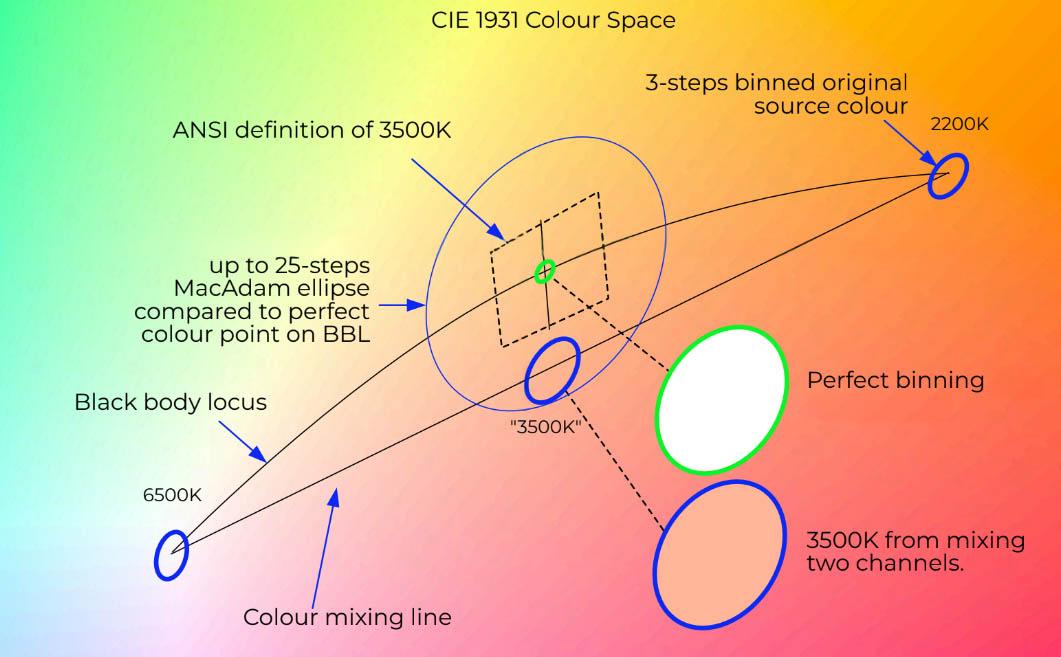
Traditional tunable white fixtures mix between a warm and cool LED. The resulting colors fall along a straight line in color space rather than following the natural blackbody/daylight curve. This produces visibly pink or green tints at intermediate CCTs and cannot reach the blue sky range above 6,500K.
The chart shows how 2-chip systems (red line) produce Duv values far outside ANSI tolerances at intermediate settings, while Circadian Sky's 4+ chip ATMOS Platform (blue line) maintains Duv ≤0.003 across the entire range.
ANSI Color Standard Compliance
ANSI C78.377 defines chromaticity regions (quadrilaterals) that a light source must fall within to claim a given nominal CCT. The chart shows how colors produced by 2-chip tunable white systems (straight line) fall outside these ANSI-defined regions at most intermediate settings — meaning those CCTs cannot be treated as valid for illumination purposes.
Sky Factory's published EP24 and IRIS RVN documentation does not include Duv, chromaticity coordinates, or ANSI C78.377 compliance data. Circadian Sky publishes full chromaticity data and maintains all CCTs within ANSI-defined white regions (2,200K–6,500K).
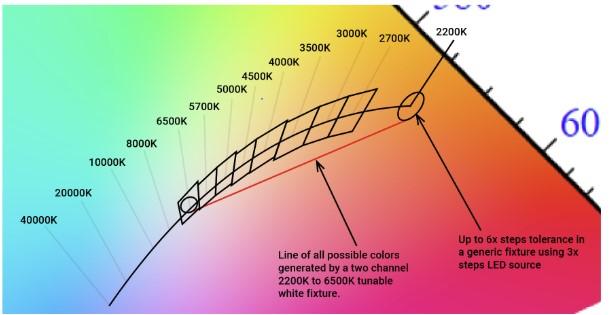
ANSI C78.377 chromaticity quadrilaterals (hatched regions) for nominal CCTs from 2,700K to 6,500K. The red line shows colors produced by a representative 2-channel tunable white fixture (2,200K to 6,500K) — many intermediate colors can fall outside the ANSI-defined valid CCT regions. Illustrative; actual chromaticity performance varies by manufacturer, LED binning, and control algorithm.
CRI & R9 Across the Full CCT Range
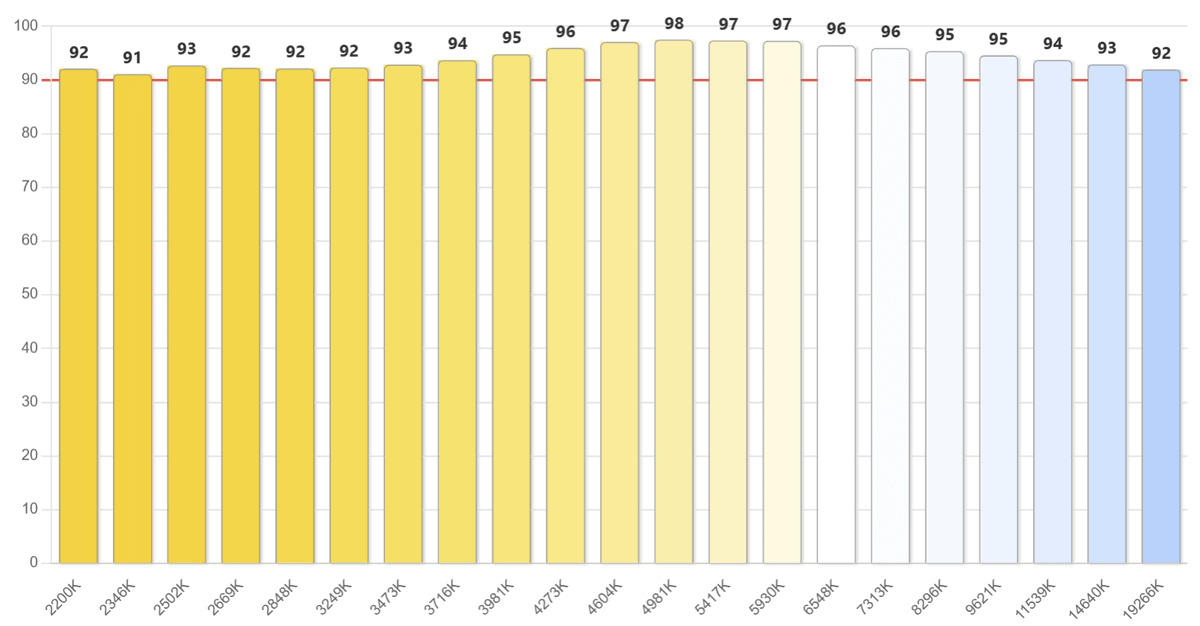
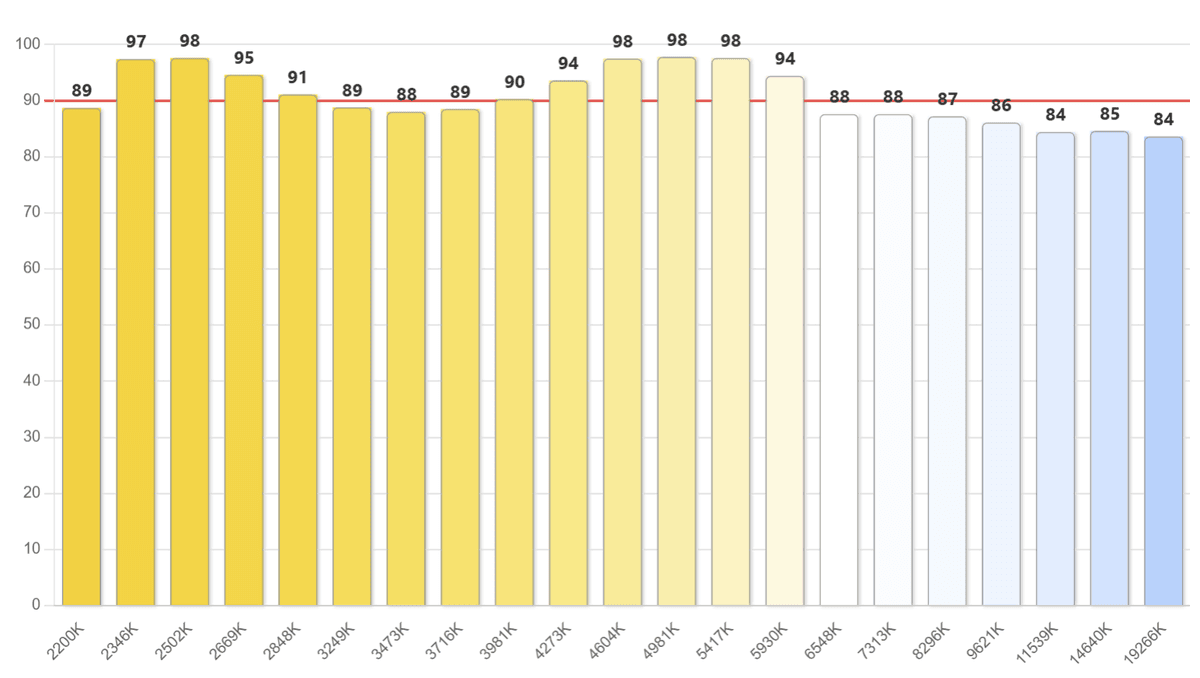
Sky Factory's published EP24 and IRIS documentation does not include CRI, R9, or color rendering data. Innerscene publishes complete photometric data including CRI (91–98), R9 (84–98), and full TM-30 color vector graphics at every CCT.
The chart shows Circadian Sky's measured CRI (Ra) values across the 2,200K–19,266K range, maintaining CRI >90 at every point. High R9 values are critical for accurate skin tone rendering in healthcare and retail environments.
Visual Appearance: Flat Image vs Depth Perception
Sky Factory products are back-illuminated photographic image panels — their own spec sheet classifies them as “photographic art luminaires.” The image is 2-dimensional by nature, and our eyes quickly perceive it as a flat surface on the ceiling. With the smallest head movement, the printed features shift relative to the viewer, revealing the surface is nearby.
Innerscene offers two fundamentally different approaches to depth — both of which produce results that no flat image panel can replicate.
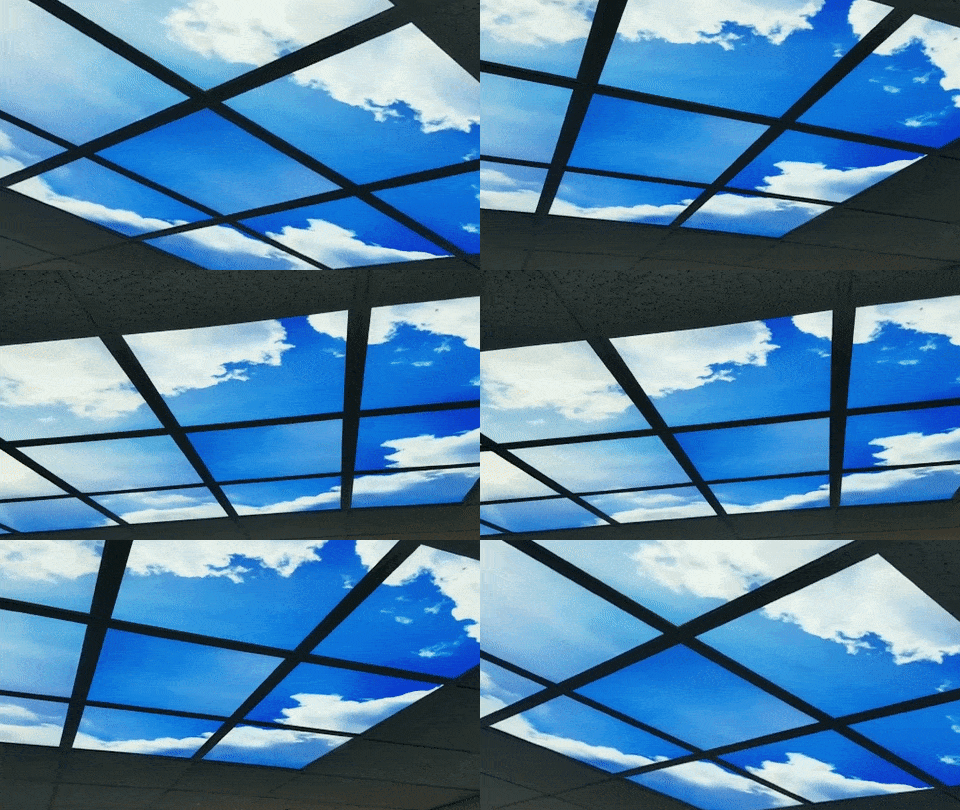
Traditional LED image panel
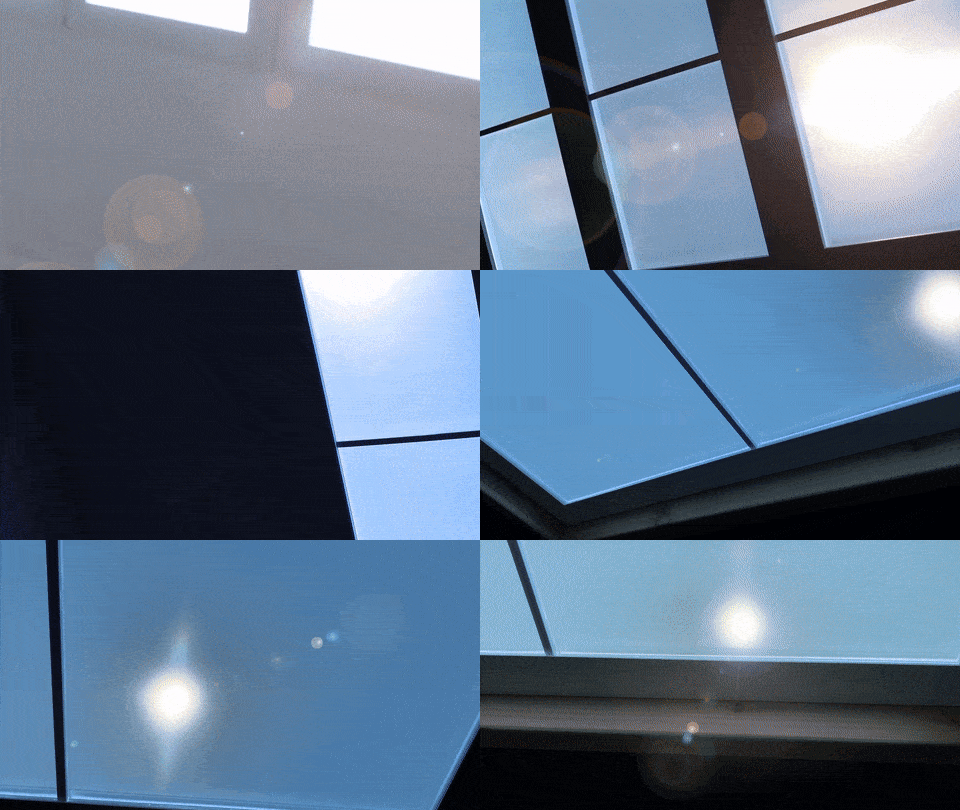
Innerscene Virtual Sun
Virtual Sun — Optical Infinity
Virtual Sun presents the sun and sky at optical infinity using patented collimating optics. Your eyes relax to far-vision focus when looking at it, just as they do when looking through a real window. The sun image tracks your head movement perfectly — staying fixed in space as if it were millions of miles away (correct motion parallax). Both eyes see the same image (correct stereopsis), confirming the “sky” is infinitely distant rather than a surface on your ceiling.
Virtual Sun also projects a 2.5° collimated sunbeam into the room, casting directional light on floors and walls that moves throughout the day — creating the complete illusion of real sunlight entering a space. CCT range: 3,200K–200,000K.
Circadian Sky — DuoGlass™ Reflective Depth
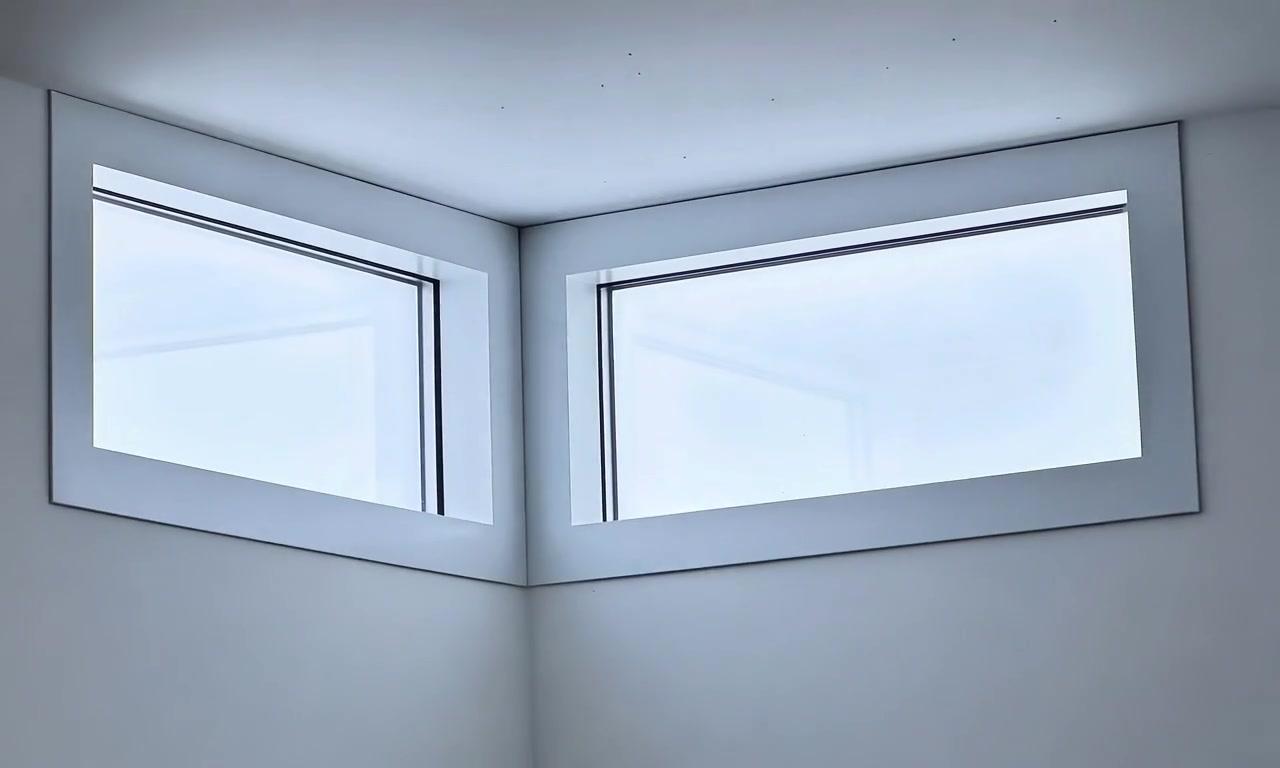
Circadian Sky uses DuoGlass™ dual-reflectance optics — two layers of highly reflective low-iron glass that replicate the double reflections found in real double-pane windows and skylights. Objects in the room and light sources appear to be reflected from behind the panel, creating a genuine perception of depth and open space above the ceiling.
Because the luminous surface is evenly lit with no distinguishing features, there are no fixed image elements that shift as you move — satisfying motion parallax expectations. Combined with full-spectrum 2,200K–40,000K light and circadian scheduling, Circadian Sky provides both the visual and biological benefits of a real skylight at only 3.3″ depth.

Virtual Sun sunbeam illumination
Multi-Chip Architecture: Factory Calibrated Precision
Innerscene's ATMOS Platform uses 4+ precisely calibrated LED chip types with per-fixture factory calibration using photometric sensors. This enables 1-step MacAdam (SDCM) color consistency and accurate color reproduction across the full 2,200K–40,000K range.
Sky Factory describes their IRIS system as using “PRiSM + DiAL algorithms” with “seven weighted wavelengths,” but does not disclose the number of LED channels, publish MacAdam step consistency, or provide any measured color accuracy data.
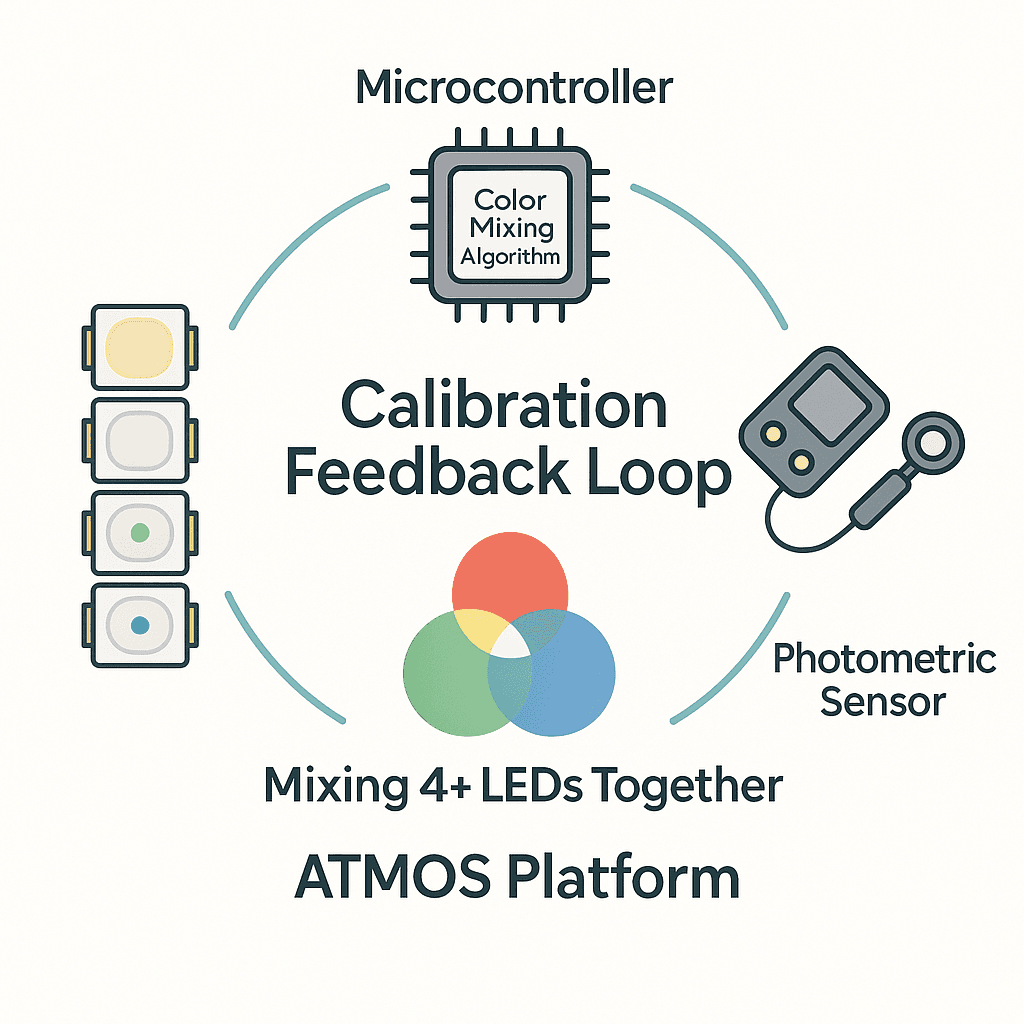
Color Consistency Between Fixtures
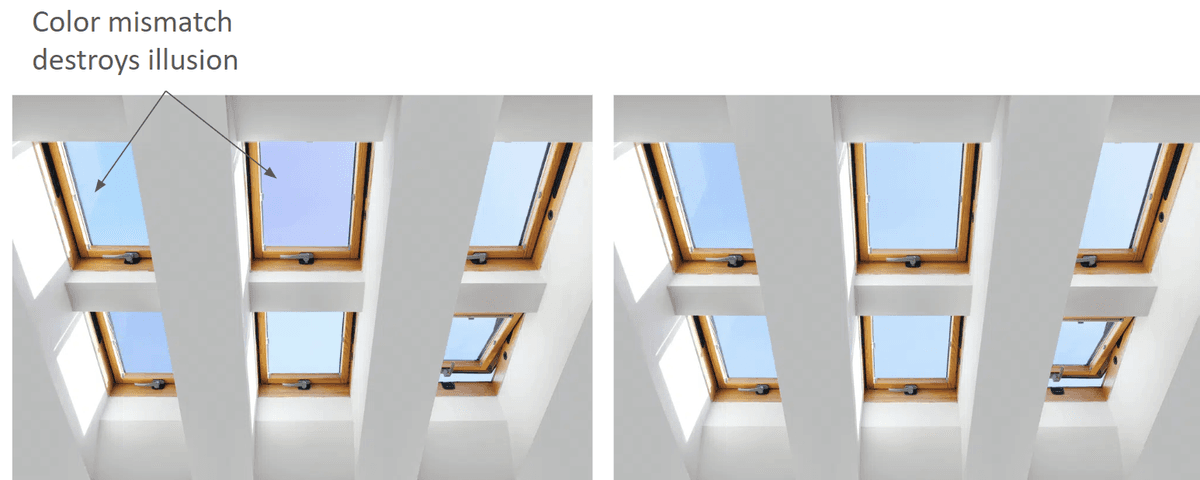
When multiple skylights are installed together, even small color differences between fixtures are immediately visible. MacAdam Ellipse steps (SDCM) measure this variation — at 3+ steps, roughly 60% of observers notice the mismatch; at 4+ steps, 90% do.
Sky Factory references “strict LED binning” but their published spec sheets do not include MacAdam step rating. Most binned LED products fall in the 3–7 step range. Circadian Sky achieves <1 MacAdam step through individual per-fixture factory calibration — a level where color variation is below the threshold of perception for nearly all observers.
R9 Deep Red & TM-30 Color Analysis
R9 measures how accurately a light source renders deep red — critical for skin tones, healthcare diagnostics, food presentation, and retail. Many LED fixtures have acceptable CRI but poor R9 values. Sky Factory's published documentation does not include R9 data.
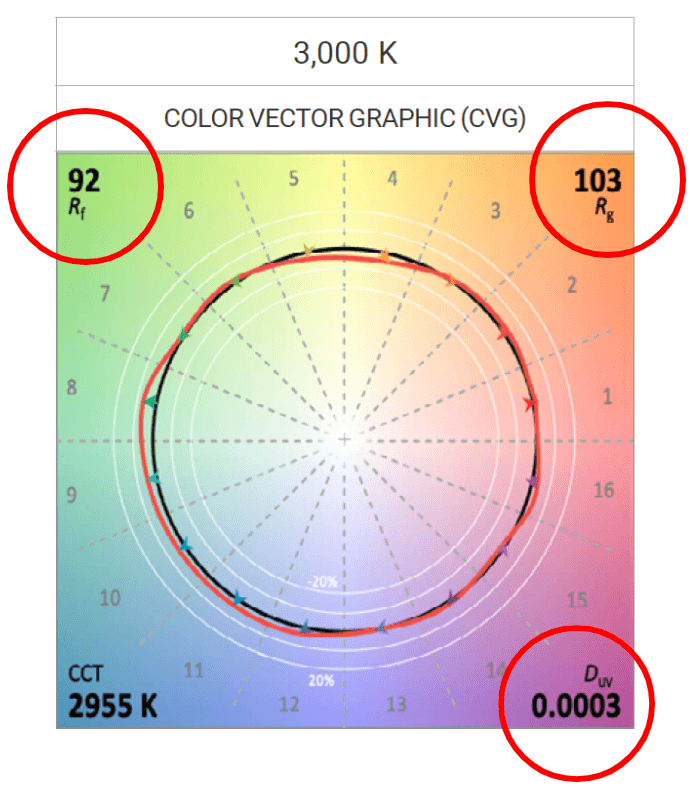
TM-30, developed by the IES, evaluates color rendering using 99 color samples (vs CRI's 8), providing a far more comprehensive picture. The Color Vector Graphic shows how light affects each hue — enabling precise evaluation of color fidelity and saturation. Sky Factory does not include TM-30 data in their published specs. Innerscene provides full TM-30 analysis at every CCT.
Melanopic Ratio & Circadian Health
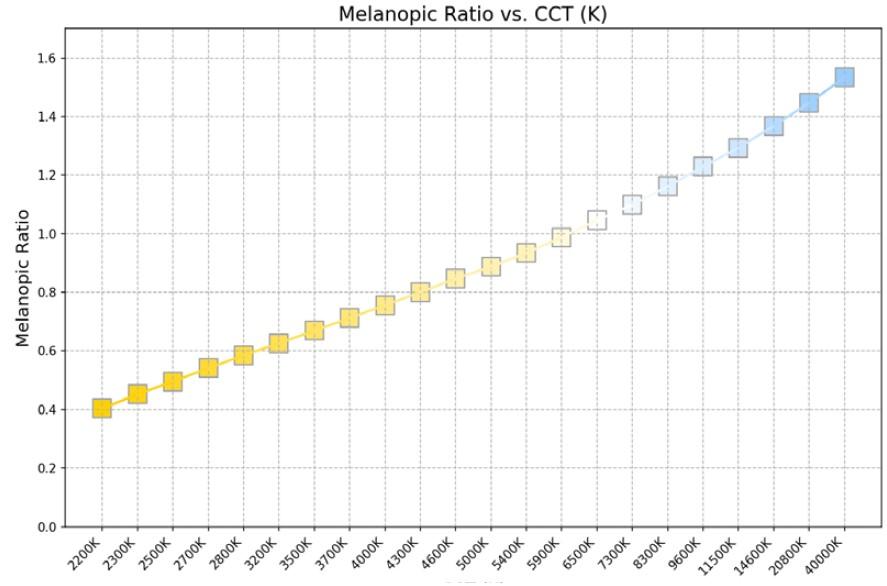
Melanopic lux measures light that stimulates the melanopsin receptors responsible for regulating our circadian rhythm. Higher melanopic ratios at a given lux level mean more circadian benefit with less total light — reducing glare and energy consumption.
Sky Factory's published documentation does not include melanopic ratio data. Circadian Sky achieves melanopic ratios from 0.4 (at 2,200K) to 1.6 (at 40,000K), while Virtual Sun reaches 0.5 to 2.1. These ratios enable WELL v2 melanopic EDI targets to be met with significantly fewer fixtures and lower illuminance levels than fixed-CCT products.
DuoGlass™ — Window-Like Reflections
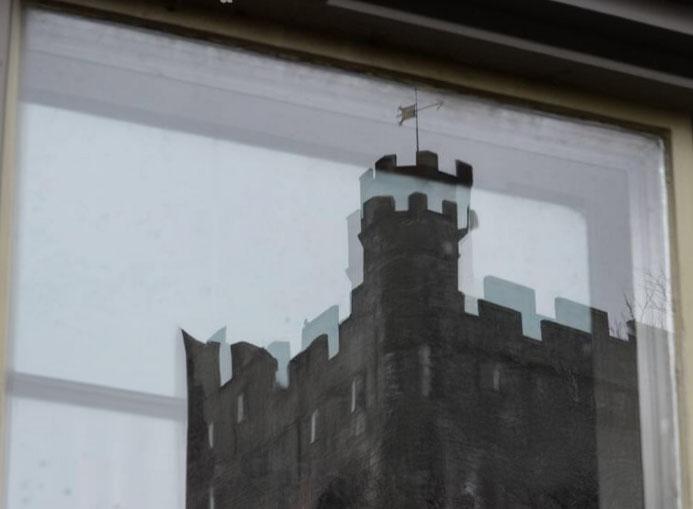
Real windows and skylights produce characteristic double reflections from their two glass panes. Our eyes unconsciously interpret these reflections as evidence that we are looking through glass into open space beyond. Circadian Sky's DuoGlass™ optics reproduce this effect using dual layers of highly reflective low-iron glass.
Sky Factory products use printed acrylic or polycarbonate SkyTiles — a single opaque image layer that produces no reflections and no depth cues. The difference is immediately apparent in person: Circadian Sky appears as an opening in the ceiling, while a backlit image panel appears as a surface on the ceiling.
Flicker-Free Operation
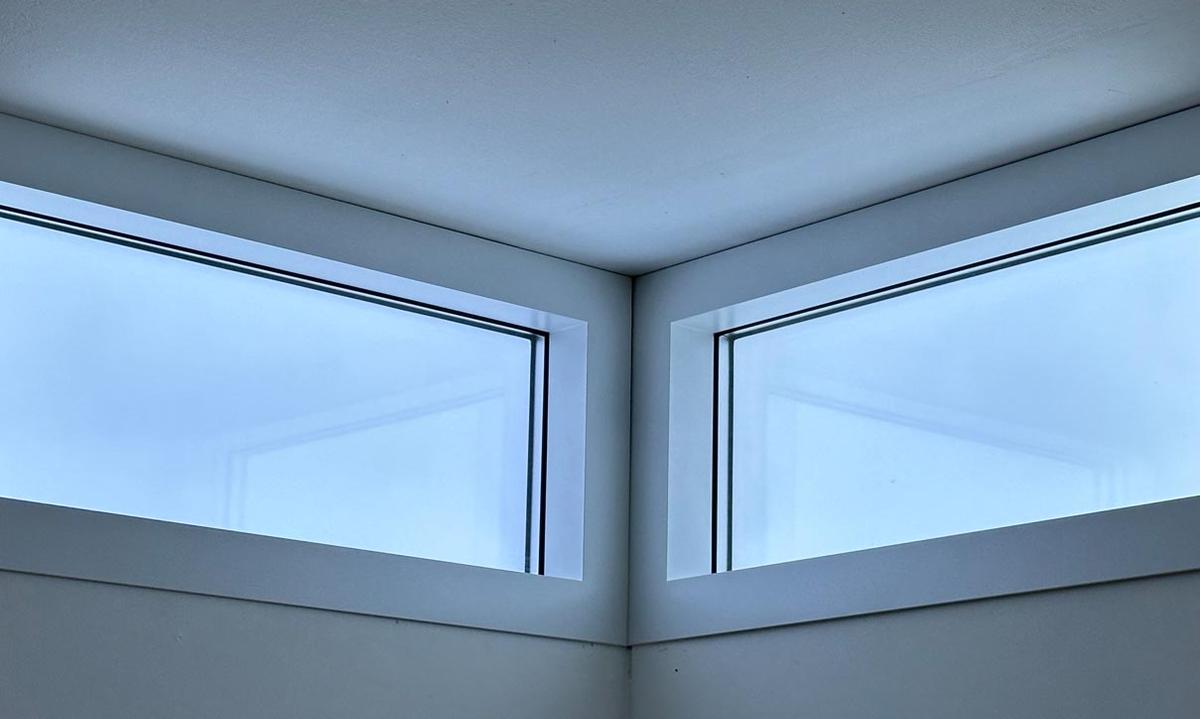
LED flicker can cause eye strain, headaches, and may trigger photosensitive conditions. It is also visible in video recordings as rolling shutter bands and can produce stroboscopic effects on moving objects. Sky Factory does not specify their PWM dimming frequency.
Circadian Sky uses 40kHz PWM dimming — well above the threshold of both human perception and camera detection — ensuring flicker-free operation at all brightness levels down to less than 1% output. This is particularly important in healthcare environments with sensitive medical equipment and in any space where video recording occurs.

SkySync — Real Sky Color Tracking
Sky Factory products operate on pre-programmed schedules or manual control. They have no ability to sense or respond to actual outdoor conditions. When clouds roll in or the sun breaks through, the fixtures continue their fixed program regardless.
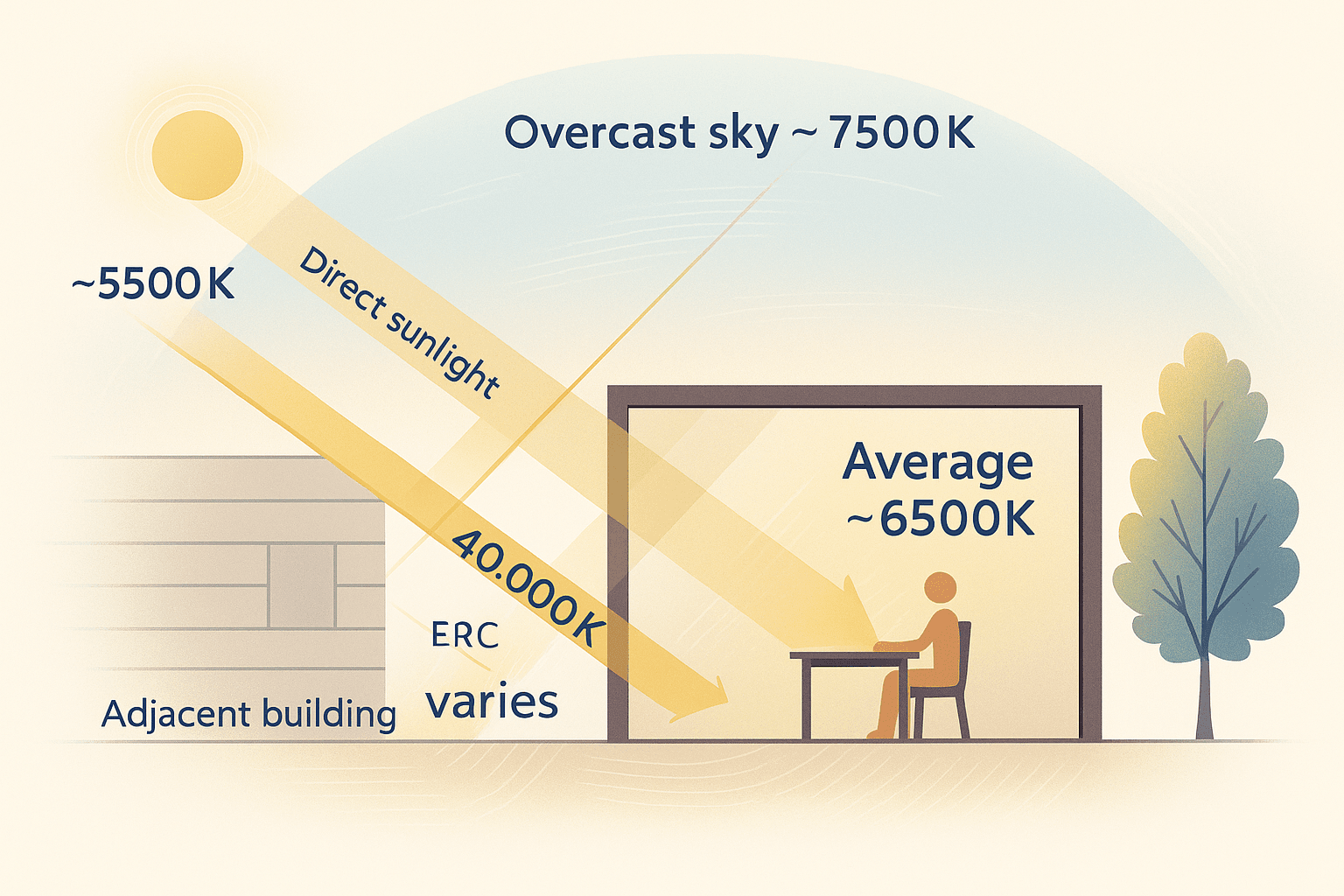
Innerscene's SkySync is the first sensor capable of capturing the true color of a blue sky and bringing it indoors. Traditional light sensors measure a mix of sunlight, reflections, and sky together, producing white, overcast-looking readings around 5,000–6,500K. But the real sky on a clear day can reach 40,000K or higher in our measurements.
SkySync's breakthrough dual-sensor technology measures the sky independently from ambient light using a 10° narrow directional sensor for true sky color and a 180° ambient sensor for diffuse environmental light. This data streams wirelessly to Circadian Sky and Virtual Sun fixtures in real time — as clouds drift by and the sun moves across the sky, your indoor lighting shifts and responds, making spaces feel alive and connected to the natural world outside.
Dual-Sensor Technology
10° narrow sensor captures true sky color (up to 40,000K+). 180° ambient sensor measures diffuse environmental light. Together they provide the complete picture that single-sensor systems miss.
Zero Maintenance
Mounts to the inside of any window — no exterior installation, no wiring, no roof penetration. 10+ year battery life with wireless communication to fixtures directly or via the Innerscene Mini Hub.
Real-Time Response
Indoor fixtures track outdoor sky continuously. When the sky shifts from warm sunrise to cool midday blue to golden sunset, your Circadian Sky and Virtual Sun fixtures follow automatically.
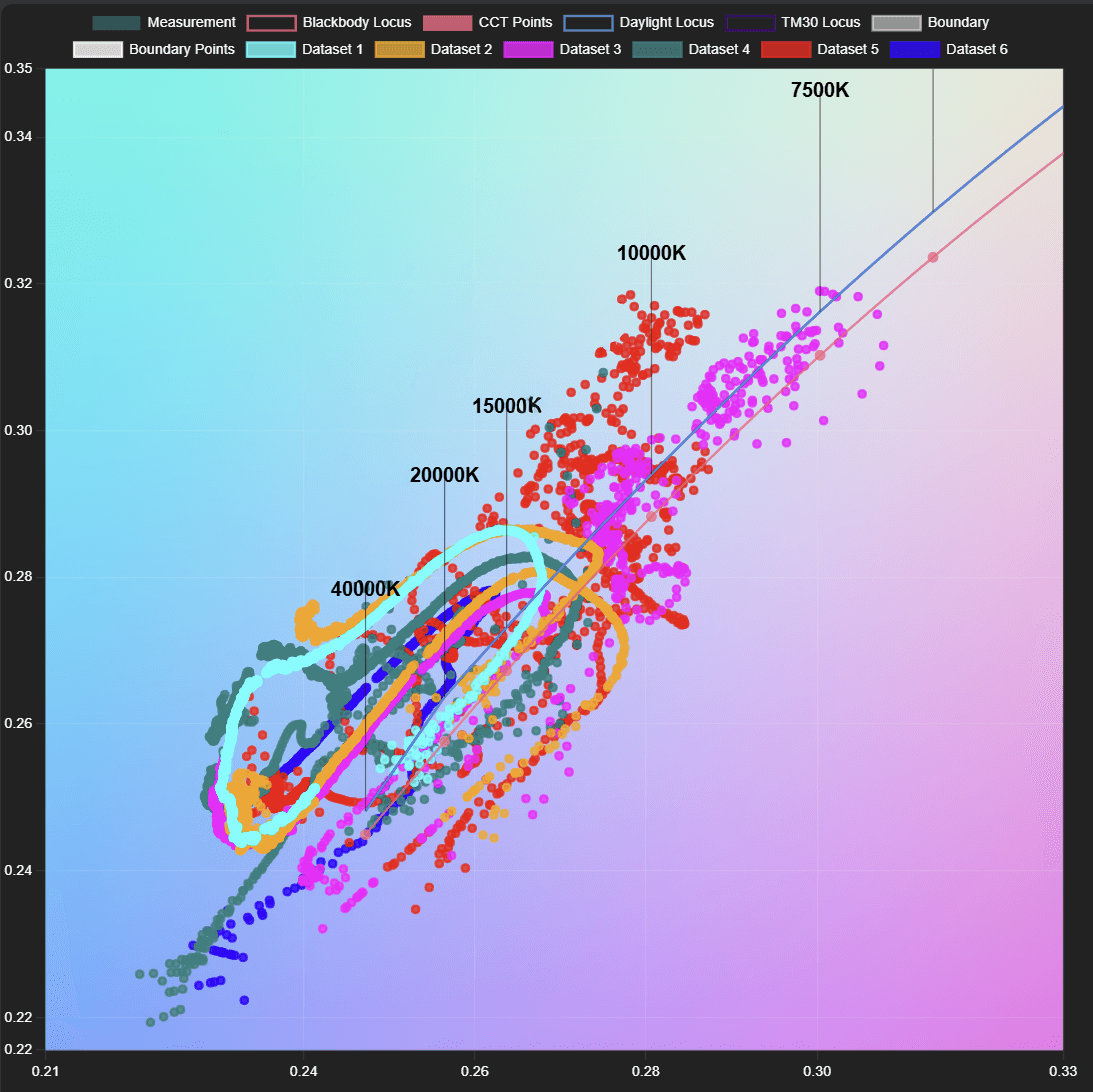
Real sky color measurements over 6 days. Each dot is a moment in time — the sky changes constantly. Cyan line: clear days. Purple dots: cloudy days.
The chromaticity diagram shows real sky color data captured by SkySync over multiple days. Each dot represents the sky's color at a specific moment. In our measurements, clear days (cyan line) often trend toward very high CCT and can reach ~40,000K with continuous variation. Cloudy days (purple dots) range from approximately 6,500K to 12,000K.
This constant, organic variation is what makes natural daylight feel alive. SkySync captures these moment-to-moment changes and streams them to your fixtures — something no pre-programmed schedule can replicate.
No Sky Factory product offers any form of outdoor sky sensing or real-time color tracking capability.
Learn more about SkySync