Why Daytime Light Should Look Like the Sky: A Plain-English Guide to Color Temperature and Your Body Clock

A few facts to set the stage:
- Swap the light in a room for a bluer white of the same brightness and people get measurably sharper: less sleepiness, faster reaction times, and changed activity in the brain regions that handle sustained attention.[8]
- The cells in your eye that read daylight wire straight into the brain's mood centers. Light can lift or flatten how you feel through a route that has nothing to do with vision, and that does not run through sleep first.[9]
- Sitting outside in the shade gives your body clock a light signal several hundred times stronger than a well-lit office desk.
- Ten feet from a window on a cloudy winter day, you receive 19 units of a daylight signal your body wants 250 of. To your internal clock, that reads as dusk, all day.
- A clear blue sky has a color temperature around 40,000K. The bluest “daylight” bulb at the hardware store stops at 6,500K.
- Your eyes contain a third kind of light sensor, alongside rods and cones, that does nothing for vision. Science only confirmed it exists in 2002.
You have probably heard that blue light is bad for you. Phone makers ship night modes, and drugstores sell blue-blocking glasses. That advice is half right: blue-rich light in the hours before bed really can push your sleep later. The missing half of the story is that during the day, the opposite is true. Your body is built to expect bright, blue-sky light from morning to late afternoon, and most of us are not getting anywhere near enough of it.
People in industrialized countries spend about 90% of their lives indoors, and most have never heard any of the numbers above. If they surprise you, the rest of this article is for you. It explains, without assuming you know anything about lighting, what the “color” of white light actually is, how your eyes use it to set your internal clock, and why choosing a cooler, bluer white during the day is one of the simplest things you can do for your sleep, mood, and focus.
What “color temperature” means
Not all white light is the same white. A candle flame, an office ceiling light, and the midday sky are all “white” light sources, but the candle looks orange, the office looks neutral, and the sky looks blue. Lighting people describe this difference with a number called correlated color temperature, or CCT, measured in a unit called kelvin (K).
You do not need the physics behind it. All you need is the ladder: low numbers look orange and cozy, high numbers look blue and crisp.
| Light source | Approximate CCT | How it looks |
|---|---|---|
| Candle flame | 1,900K | Deep orange |
| “Warm white” household bulb | 2,700K | Golden, cozy |
| Typical office lighting | 3,500–4,000K | Neutral white |
| Midday sun | 5,500K | Bright white |
| Overcast sky | 7,500K | Cool white |
| Clear blue sky | up to 40,000K | Vivid blue |
One quirk of the naming: high-kelvin light is called “cool” because it looks blue, and low-kelvin light is called “warm” because it looks orange, even though the kelvin numbers run the other way. In this article, “cool” and “bluer” mean the same thing: higher CCT.

Notice what this table says about the light we evolved under. For roughly half of every day, our ancestors were outdoors under a 5,500K sun and a sky that ranged from 7,500K on gray days to 40,000K on clear ones. Then the sun set, and light dropped to firelight at under 2,000K. Our bodies grew to expect that daily swing: blue and bright by day, orange and dim by night. Modern buildings flattened it into a constant 3,500K at every hour, and our biology noticed.
The light sensor in your eye that is not for seeing
The reason the color of light matters, and not just its brightness, comes down to a discovery made surprisingly recently. Your retina contains the rods and cones you learned about in school, which handle vision. But in 2002, researchers confirmed a third kind of light sensor: intrinsically photosensitive retinal ganglion cells, mercifully shortened to ipRGCs.[1]
These cells do not help you see. They contain a pigment called melanopsin, and their job is to report to your brain how much daylight you are getting. They feed a small region of the brain that acts as your master clock, the one that decides when you feel alert, when hormones like cortisol and melatonin rise and fall, and when you get sleepy at night.[2]
The crucial detail is which light these cells respond to. Melanopsin is most sensitive to sky-blue light, at wavelengths around 490 nanometers. Orange and red light barely register. In other words, your body clock is tuned specifically to the color of the daytime sky. That is not a coincidence: the blue sky was the one light signal that reliably meant “it is daytime” for the entire history of our species.
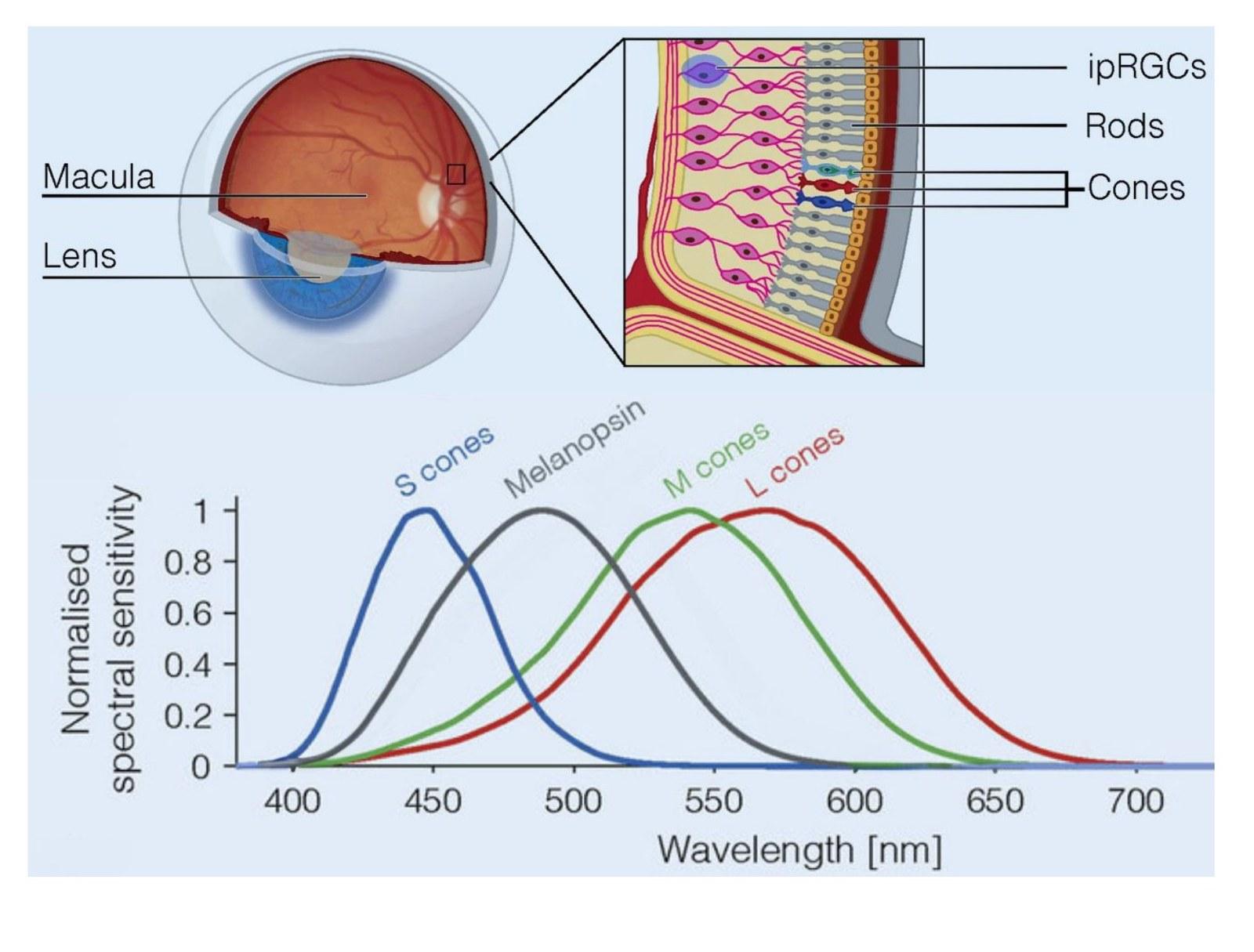
Since their discovery, research on these cells has grown from a handful of papers to hundreds, linking daytime light exposure to an unexpectedly wide range of body systems:[3]
- Sleep: strong daytime light keeps melatonin release on schedule, so you fall asleep more easily at night
- Alertness and focus: the same signal suppresses daytime grogginess and supports concentration and reaction time
- Mood: light exposure is a first-line treatment for seasonal depression, and brighter days are consistently linked with better self-reported mood
- Hormones and metabolism: the master clock times cortisol, melatonin, digestion, and body temperature, all of which drift when the light signal is weak
How scientists measure “useful” daylight
Ordinary brightness is measured in lux. A dim living room might be 50 lux, a well-lit office 300 to 500 lux, and outdoor daylight tens of thousands of lux. But lux is weighted toward the green light your cones see best, so it tells you how bright a room looks, not how strongly it is talking to your body clock.
For that, researchers use melanopic lux, formally called melanopic EDI (you may also see the older term EML).[4] It re-weighs light according to what the ipRGCs respond to. Two rooms can look equally bright while one delivers three times the melanopic lux of the other, simply because its light contains more sky-blue wavelengths.
In 2022, a group of leading circadian researchers published consensus recommendations for healthy light exposure, and they are refreshingly simple:[5]
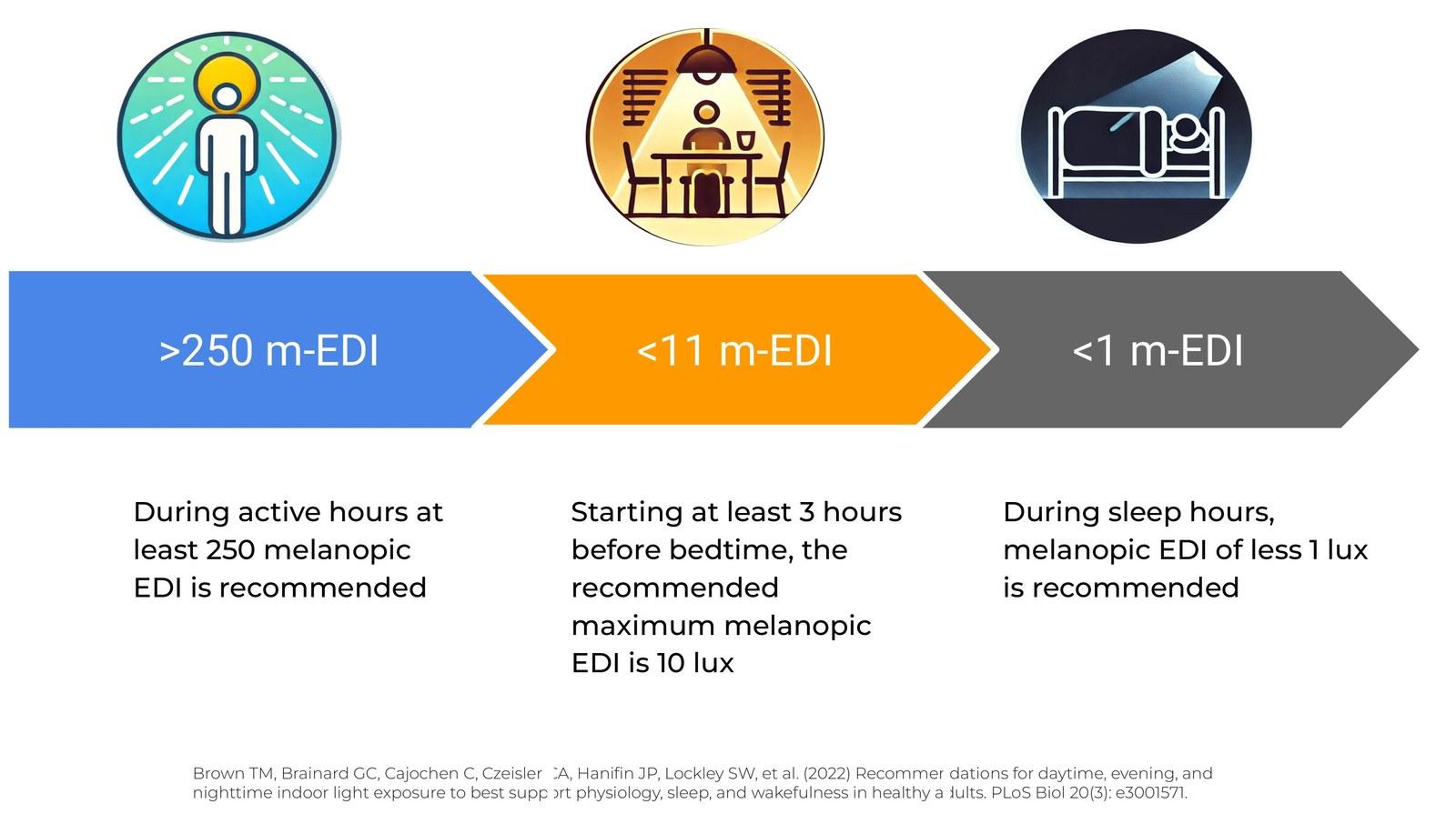
The building industry is moving the same direction: the WELL Building Standard, a health-focused certification for offices and other spaces, awards its top lighting credit at that same 250 level during working hours.[6]
Why indoor light usually falls short
Here is the uncomfortable part. People in industrialized countries spend about 90% of their time indoors, and indoor light is dramatically weaker than it feels. Your eyes adapt so smoothly that a 300-lux office and a 30,000-lux sidewalk seem vaguely similar, but to your body clock they are night and day, almost literally.
Even a window helps far less than intuition suggests, because light falls off quickly as you move away from it. Measurements of a person facing a standard double-pane window show the drop:[7]
| Where you are | Sunny summer day | Cloudy winter day |
|---|---|---|
| Outside | 143,000 melanopic lux | 2,800 melanopic lux |
| 1 foot from the window | 17,700 | 1,900 |
| 10 feet from the window | 177 | 19 |
Ten feet from a window on a gray winter day, you are getting 19 melanopic lux against a recommended 250. A desk in the interior of a building, under standard 3,500K ceiling lights, typically lands somewhere between 50 and 80. That is not a small shortfall. It means many office workers, hospital patients, and students spend their entire waking day in what their body clock reads as deep twilight.
The role of color temperature: more clock signal at the same brightness
So how do you close a gap like that? One option is brute force: make the lights much brighter. But a fixture bright enough to deliver 250 melanopic lux from warm-white LEDs is genuinely unpleasant to sit under. Past a point, added brightness turns into glare, squinting, and headaches.
The better lever is color. Because ipRGCs respond mainly to sky-blue wavelengths, raising the color temperature raises the clock signal without raising the brightness. Lighting engineers capture this in a number called the melanopic ratio: how much melanopic lux you get per ordinary lux. The relationship with CCT is remarkably direct:
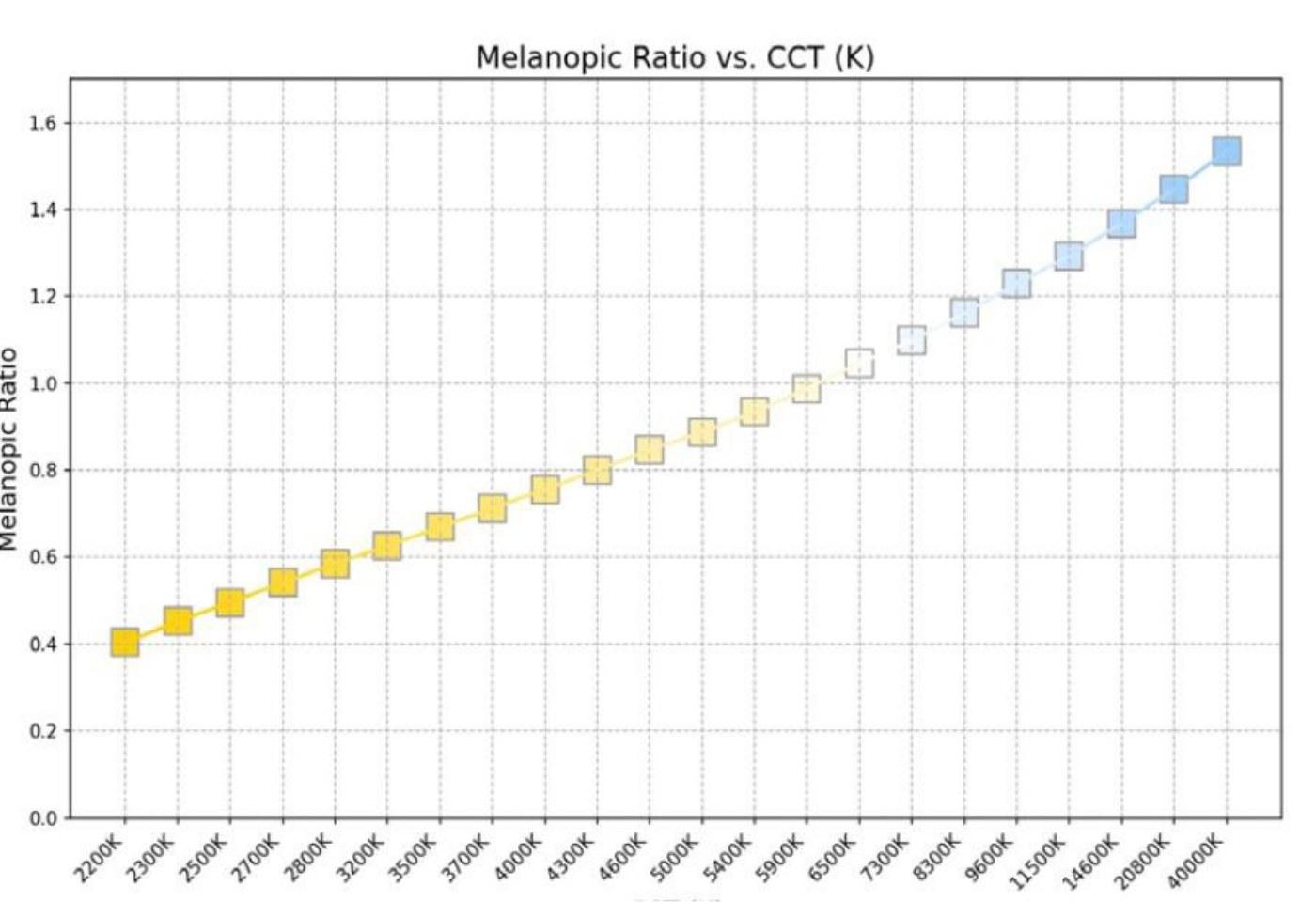
Read that chart as a multiplier on everything your lights do for your body clock. Going from a warm 2,700K bulb (ratio about 0.54) to a blue-sky 40,000K source (ratio about 1.5) nearly triples the circadian effect of the same measured brightness. Put concretely: to reach the recommended 250 melanopic lux at eye level, you need roughly 330 lux of 4,000K office light, but only about 170 lux of very high-CCT sky-colored light, a level most people find comfortable rather than harsh.
A worked example from our course materials makes the same point. A standard 2×4-foot ceiling fixture running at 3,500K delivers at most about 80 melanopic lux to a person seated nearby, a third of the recommended daytime level. The identical fixture output at a 40,000K sky color delivers over 300, comfortably past the target, with no increase in brightness.[7]
This is the whole argument in one sentence: during the day, a bluer white gives your body the daylight signal it evolved to expect, at a brightness your eyes actually enjoy.
Will the room look blue?
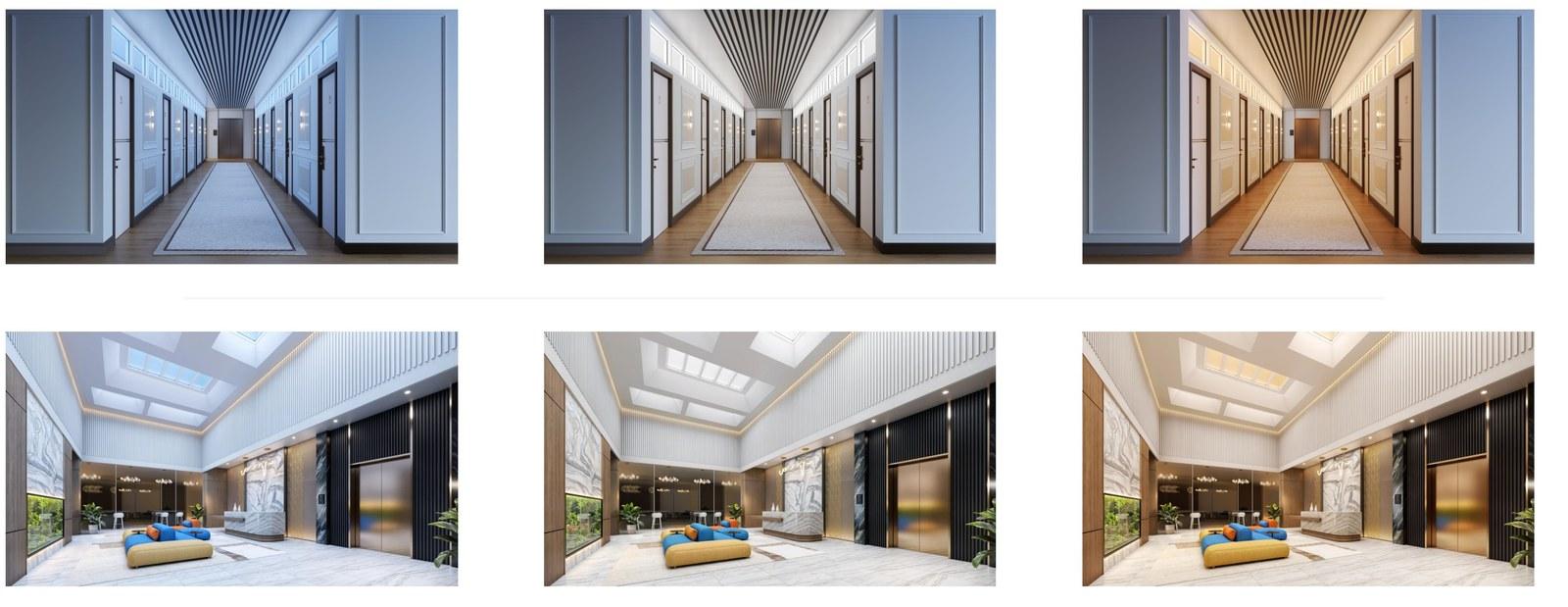
Less than you would think. Your visual system continuously white-balances the world, a reflex called chromatic adaptation. Walk into a room lit at a high color temperature and you notice a crisp, blue cast for a few minutes; then your brain neutralizes it, white paper looks white again, and the room simply reads as bright and airy. Phone cameras imitate exactly this reflex with their automatic white balance, which is why photos taken under different bulbs all look roughly normal.
You already know the sensation from outdoors: nobody describes a sunny day as sitting in blue light, even though, measured objectively, it is.
The evening half of the bargain
Everything above comes with a flip side, and it is the part the blue-light warnings got right. The same ipRGCs that wake you up at noon will happily delay your sleep at 11pm. The recommendations are symmetrical: under 10 melanopic lux in the last few hours before bed, and under 1 while you sleep.[5] In practice that means warm, dim light in the evening: table lamps instead of ceiling lights, 2,700K or warmer, turned well down.
So “blue light is bad” was never quite the lesson. The lesson is that your body wants contrast: a strong sky-colored signal during the day and the near-absence of one at night. A dim office by day and a glowing phone by night is precisely backwards, and delivers the worst of both.
What you can do
- Get outside in the morning. Even 15 minutes outdoors delivers more melanopic light than most people get from a full day inside. It is the cheapest circadian intervention there is.
- Work near a window if you can. The falloff table above cuts both ways: the first few feet from the glass are worth a lot.
- Use cooler bulbs where you spend your day. In a home office or kitchen, choosing 5,000K–6,500K “daylight” bulbs for daytime rooms raises your melanopic dose at no cost in brightness. Keep bedrooms and evening spaces warm.
- Dim and warm the evening. Low lamps, warm color, screens down. Protecting the last three hours before bed matters as much as brightening the day.
- For windowless spaces, consider lighting built for this. Ordinary tunable fixtures stop around 6,500K, well short of sky colors. Our Circadian Sky virtual skylights reach true blue-sky color temperatures up to 40,000K and follow the day automatically, from sunrise warmth to midday blue to candle-warm evening levels.
Further reading
- The Other Side of the Blue Light Story: a deeper, research-cited look at daytime melanopic light.
- Replicating natural daylight indoors: what it takes to recreate daylight where windows are not an option, from sky color temperatures and spectrum through depth perception, with a ten-point checklist for judging any product.
- Circadian Lab: a free tool that simulates a room and shows the melanopic light each occupant actually receives.
- Our AIA continuing-education course: an hour-long session for architects and designers covering these topics in depth, including the diagrams used in this article.
References
- Berson DM, Dunn FA, Takao M. (2002) Phototransduction by retinal ganglion cells that set the circadian clock. Science 295(5557):1070–1073.
- Hattar S, Liao HW, Takao M, Berson DM, Yau KW. (2002) Melanopsin-containing retinal ganglion cells: architecture, projections, and intrinsic photosensitivity. Science 295(5557):1065–1070.
- LeGates TA, Fernandez DC, Hattar S. (2014) Light as a central modulator of circadian rhythms, sleep and affect. Nature Reviews Neuroscience 15(7):443–454.
- CIE S 026:2018. CIE System for Metrology of Optical Radiation for ipRGC-Influenced Responses to Light.
- Brown TM, Brainard GC, Cajochen C, Czeisler CA, Hanifin JP, Lockley SW, et al. (2022) Recommendations for daytime, evening, and nighttime indoor light exposure to best support physiology, sleep, and wakefulness in healthy adults. PLoS Biology 20(3):e3001571.
- International WELL Building Institute. WELL v2, Feature L03: Circadian Lighting Design.
- Innerscene. (2024) Beyond the Surface: Adding Daylight and Depth with Virtual Skylights and Windows. AIA continuing-education course materials.
- Souman JL, Tinga AM, te Pas SF, van Ee R, Vlaskamp BNS. (2018) Acute alerting effects of light: a systematic literature review. Behavioural Brain Research 337:228–239. See also Vandewalle G, Maquet P, Dijk DJ. (2009) Light as a modulator of cognitive brain function. Trends in Cognitive Sciences 13(10):429–438.
- Fernandez DC, Fogerson PM, Lazzerini Ospri L, et al. (2018) Light affects mood and learning through distinct retina-brain pathways. Cell 175(1):71–84. See also LeGates et al. (2014), reference 3.
Published by Innerscene on 2026-08-12