What Separates Real Daylight From a Bright Ceiling
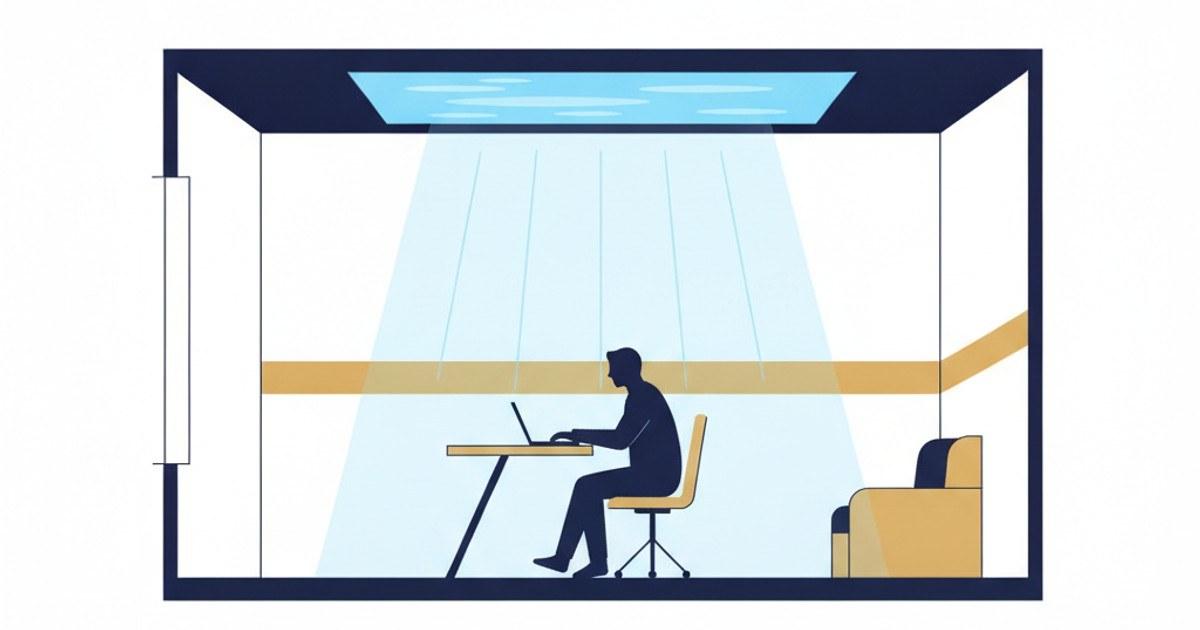
Search for how to bring daylight into a windowless room and the advice is remarkably consistent: paint the walls white, hang a mirror, buy a “daylight” bulb. All of that makes a room brighter. None of it makes a room feel like it has a window, because brightness is only one of the properties that define daylight, and your eye and your body respond far more strongly to the others.
This is the short version of a longer guide we published on replicating natural daylight indoors. Here are the four properties that matter, and what usually goes wrong with each.
1. The spectrum, and a color temperature nobody quotes
Direct sunlight sits near 5,500 K and an overcast sky near 7,500 K, but the clear blue dome overhead, which is what you actually see through a skylight with no sun in view, runs to 40,000 K. A room lit only by sky light can average tens of thousands of kelvin. Any product that stops at 6,500 K, which is where most tunable-white fixtures top out, is not producing sky color at all.
Color temperature alone is also not enough, because chromaticity has two dimensions. The second one, Duv, measures how far the light sits above or below the reference curve, and standards allow at most 0.005 before light reads as visibly tinted. A two-channel tunable white fixture blends a warm and a cool LED, and mixing two sources can only produce colors on the straight line between them. Daylight follows a curve. In the middle of the range that gap opens to roughly double the standard, which is why tunable white so often looks faintly pink at intermediate settings.
RGB and RGBW panels fail differently. Three narrow primaries can mix a white at any chromaticity, but everything between the peaks is missing, and a room is seen almost entirely by reflected light. We modeled typical tile primaries with the CIE 13.3 method: RGB alone lands at a color rendering index of 17 to 29, with deep reds so distorted they score below zero. Adding a white channel helps, but an 80-CRI white only delivers its 80 at its own color temperature; dial the panel warmer and rendering falls to the 30s and 40s.
2. The dose your body reads, which your meter misses
A third class of photoreceptor in the retina, confirmed in 2002, reports light to the brain region that sets your internal clock. It peaks in the cyan band near 490 nm and contributes almost nothing to vision, so ordinary lux misses it. The measure that captures it is melanopic EDI, taken vertically at the eye.
The outdoor-to-indoor falloff surprises nearly everyone. On a sunny day you receive about 143,000 melanopic EDI outdoors, about 17,700 a foot from a window, and 177 ten feet from that same window. On a cloudy winter day, ten feet from the window leaves you with 19, against a recommended daytime exposure of 250. This is the gap a virtual skylight has to close, and it is why color temperature matters twice: melanopic ratio climbs with CCT, so sky-blue light delivers several times the circadian stimulus of warm light at the same visual brightness.
3. Change, all day long
Outdoors, color and intensity shift minute by minute. A fixed setting, however accurate, is a photograph of daylight. The full requirement runs in both directions: at least 250 melanopic EDI during the day, below 10 in the few hours before bed, and below 1 during sleep. A system that can only go bright and blue solves half the problem and creates the other half.
4. Depth, which is where most products give themselves away
Get the light right and a flat panel still fails, because the visual system judges distance several independent ways. Binocular vision compares the images from your two eyes; motion parallax compares how a scene shifts as you move; focus and eye convergence both settle at the distance of whatever you are looking at. A printed or screen-based sky satisfies none of them: it sits on the ceiling plane, and every cue says so within seconds of walking into the room. Printed clouds make it worse: fixed image features give the brain anchor points whose unchanging positions prove the surface is flat.
What works is putting real focal points behind the fixture. Collimating optics can place a sun image at optical infinity. A reflective glass layer over a sky panel does it a second way: an opposing light source in the room mirrors in the glass, and that reflection is a true optical image sitting behind the ceiling plane at the source’s own distance, so it moves correctly as you walk and both eyes converge on it exactly as they would on something beyond the ceiling. A recess of two to four inches and the offset double reflection of real double-pane glazing complete the effect.
The ten tests
All of it condenses into ten questions worth asking of any product that claims to replicate daylight:
- 1. A continuous daylight spectrum, including the 480-500 nm cyan band
- 2. Color temperatures above 20,000 K for sky, down to about 2200 K for evening
- 3. CRI 90 or higher with R9 at least 50, held at every color temperature
- 4. Duv within 0.005 across the full tuning range
- 5. 1 MacAdam step between fixtures, at the fixture, across CCTs and dimming levels
- 6. Published melanopic ratios high enough for 250+ m-EDI by day and low enough for night
- 7. Automatic scheduling on a solar or wall clock
- 8. Real focal points behind the fixture plane: recess, reflections, or collimated optics
- 9. PWM at 10,000 Hz or higher, or analog dimming
- 10. UL or ETL listing for the complete fixture, no UV, and a lighting power density your code allows
Most of these are numbers a manufacturer either publishes or does not. Two questions separate a real answer from a flattering one: does the figure describe the LED chip or the finished fixture, and does it hold across the whole tuning and dimming range or only at one favorable setting?
Read the full guide
The complete version of this material, replicating natural daylight indoors, works through each property with interactive charts: a chromaticity diagram you can drag through the color temperature range to watch tunable white drift off the daylight curve, a spectrum comparator, a simulated ceiling array showing what each color tolerance looks like, and animations of the depth cues.
The material began as Beyond the Surface, our AIA continuing-education course on adding daylight and depth to windowless spaces. You can watch the narrated slides, or register for the live session for AIA LU/HSW credit.
Published by Innerscene on 2026-09-08