Patient Room Lighting Design: What the Research Says, and Six Approaches Compared
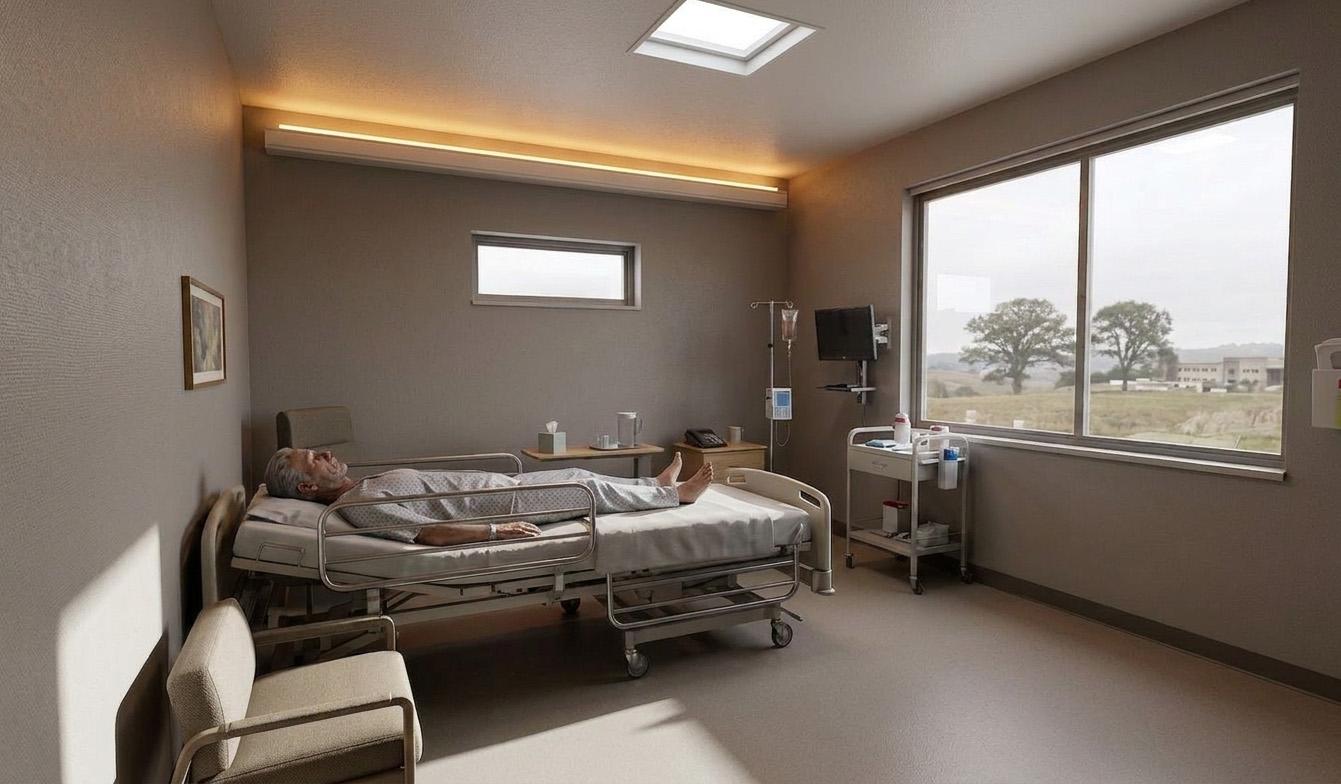
The patient room is one of the hardest spaces in a building to light well. The person it serves spends nearly the whole day in bed, often on their back looking at the ceiling, at exactly the time a healthy circadian rhythm needs bright, blue-rich daytime light and dark, warm nights. The same room has to become an exam room on demand, a place to read, and a place to sleep, and it has to do all of that without shining glare into the eyes of someone who cannot look away. Good research exists for every piece of this. Below we summarize what it says, then compare six real lighting approaches with results computed in CircadianLab, each with a link you can open and explore. One result to hold on to as you read: hitting the circadian number turns out to be easy, and every design here does it. What separates the six is glare, judged the way the patient actually sees it, and what happens when the bed moves.
What the research says
Four requirements set the numbers: circadian light (mel-EDI), illuminance for exam and navigation, glare (UGR) for a patient looking up, and spectrum. Expand for the standards and citations behind each.
Circadian light (mel-EDI)
Circadian light is measured as melanopic EDI (equivalent daylight illuminance), which quantifies the melanopsin-effective part of the light reaching the eye, read vertically at eye level. It describes the light stimulus, not the full biological response, which also turns on timing, duration, prior light history, and the individual. Used as a design metric, the consensus recommendations for healthy day-active adults call for at least 250 mel-EDI during the day, under 10 in the evening (from about three hours before bed), and under 1 at night in the sleep environment, with up to 10 allowed for unavoidable tasks that need vision.[1] WELL v2 sets a daytime bar in two tiers, 136 mel-EDI (Tier 1) and 250 (Tier 2), sustained for at least four hours beginning by noon at the latest, on the vertical plane at eye level,[2] and ANSI/IES RP-46-25 likewise recommends a daytime minimum of 250 mel-EDI at the eye.[3] Those figures come from studies of healthy adults, and a patient population also includes children, older eyes, and the sedated, so treat 250 as a sound design benchmark rather than a validated clinical dose for every patient. It is a useful benchmark to design toward: bright daytime light has been associated with better sleep and less delirium in hospitalized patients, though intervention trials are mixed and no study shows that hitting 250 mel-EDI on its own prevents delirium.
The crucial detail for a patient room is where you measure. An office worker's circadian light is read looking forward; a bedridden patient's is read looking straight up at the ceiling. That is a different number, and CircadianLab now evaluates mel-EDI (and glare) in that upward "lying down" direction, which is how every result below is computed.
Illuminance: exam and navigation
A patient room needs very different light levels at different moments. ANSI/IES RP-29-25, the healthcare lighting Recommended Practice, and EN 12464-1 in Europe give the working numbers: roughly 10 footcandles (100 lux) for general lighting and 30 fc (300 lux) for reading.[4][5] For the exam, RP-29 puts a patient examination at about 50 fc, and EN 12464-1 calls for 300 lux (30 fc) for a simple exam, rising to 1,000 lux (100 fc) for examination and treatment.[5] RP-29 is guidance, not a legal floor, so it binds a project only where a code, contract, or authority adopts it. At the other end, navigation, a patient getting up at night and staff moving around, needs a few footcandles on the floor for safe footing, down to a dim 0.4 fc night-observation minimum.[4] No single fixed setting spans exam brightness to night dimness, which is why tunable control matters as much as the fixture. In the comparison we report both the brightness at the bed (for reading and exam) and the average on the floor (for navigation).
Glare (UGR), the supine problem
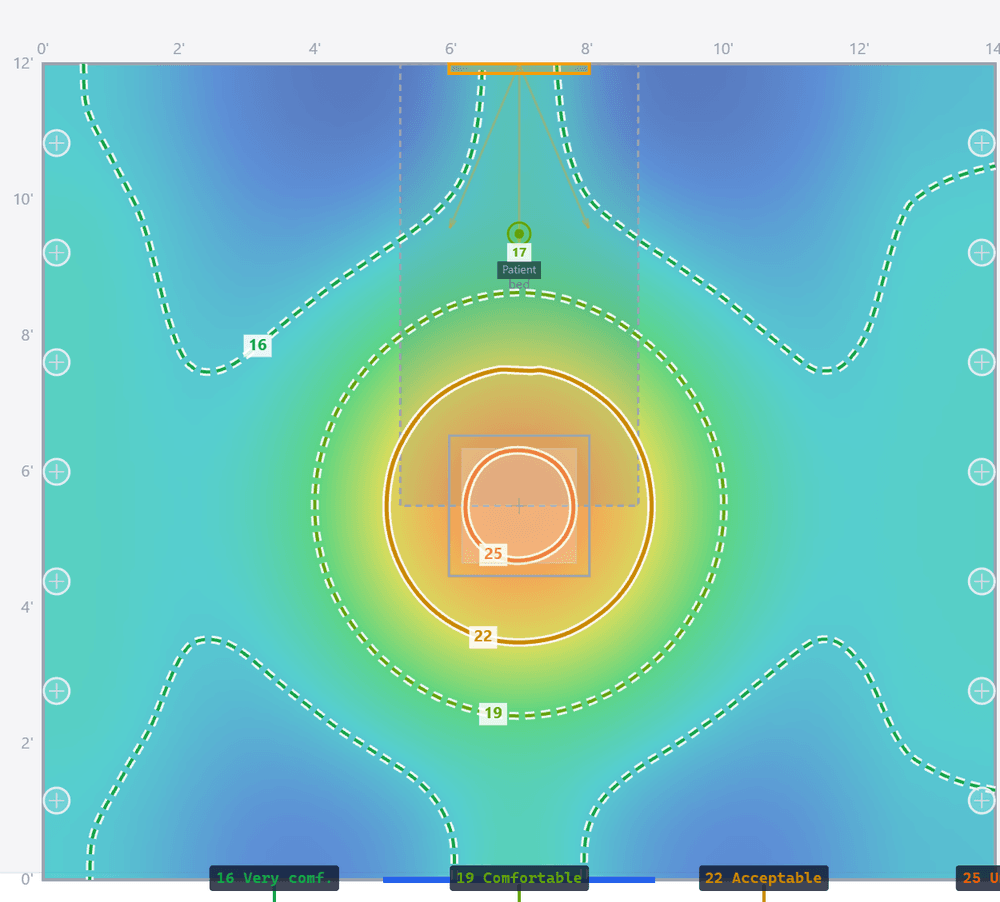
Discomfort glare is rated on the UGR scale, which runs in roughly three-point steps from imperceptible to intolerable. Healthcare standards hold visual tasks and the exam to UGR 19 or below.[5] No standard defines a limit for a patient staring straight up (the standards assume a seated, horizontal gaze), so for that supine view we pass the room at UGR 22, one step up the scale, and flag anything over 19 as past the stricter task limit; above 22 the readings climb through unacceptable (25) to intolerable (28+). A patient room has a glare problem no office has: the occupant lies on their back and looks straight up, so any bright ceiling fixture sits directly in the center of their gaze, the single worst place for a glare source, with nowhere else to look. For this reclined view the SLL guidance caps luminaire luminance at roughly 1,500 cd/m² surface-mounted and 1,000 cd/m² recessed.[6] A note on method: UGR is defined for interior electric lighting, so the window figures later apply the same formula with the sky as the source. They are engine estimates for comparison, not a standards-grade daylight-glare rating (for which DGP is the validated metric). The practical rule, which the comparison below makes vivid: a bright source anywhere in the patient's upward view is uncomfortable, and the fix is to move the source out of that direct upward line of sight, or bounce it off the ceiling. This is exactly the case CircadianLab's looking-up glare view is built to reveal.
Spectrum (color and CCT)
Spectrum does two jobs at once. For clinical accuracy, staff assess skin tone, cyanosis, and jaundice under the room light, so healthcare standards call for a high color rendering index, CRI (Ra) 90 or above.[5] For circadian effect, the same spectrum should be blue-rich and cool by day and shift warm and low-blue in the evening and night to protect sleep. A fixed 3500 K white fixture can only ever sit in the middle, never fully daylight, never truly warm, which is a limitation the comparison makes visible.
Six approaches, compared #
We modeled the same 14 x 12 ft room, 9 ft ceiling, bed against the north wall, and lit it six ways. For each we show the 3D scene, the mel-EDI and the looking-up glare (UGR) plans, and the numbers computed at the patient's eye in the daytime setting. The first two put light straight overhead; the rest move it out of the patient's upward gaze. Open any model to explore it.
All figures are computed at the supine patient's eye, looking up, with electric light only. "Bed" is the brightness at the bed for reading and exam; "Floor" is the room average for navigation. Circadian Sky is priced per square foot of panel. Most patient sleeping rooms have a window, so every model you open below, and every heatmap thumbnail marked "with window", includes a worst-case window (regulation-minimum size, overcast Seattle winter noon); its effect on each design is covered after the comparison, and deleting the window in the tool reproduces the electric-only figures.
| # | Approach | mel-EDI / UGR | Sitting up | Key shortcoming |
|---|---|---|---|---|
| 1 | Conventional troffer | 280 / 32.8 | Fails | Intolerable glare lying flat; fixed 3500 K, low CRI, no exam |
| 2 | Ceiling panels | 867 / 33.6 | Fails | Bright surfaces overhead, intolerable glare lying flat |
| 3 | Headwall panel | 513 / 19.7 | Fails | Acceptable glare, but under-doses once the patient sits up |
| 4 | Cove + headwall panel | 365 / 11.7 | Fails | Best when flat, but the dose collapses sitting up |
| 5 | Side wall panel | 277 / 11.6 | Fails | Meets the dose flat, but it collapses as the bed rises |
| 6 | Cove + headwall + overbed panel | 444 / 18.4 | Holds | Most fixtures and cost of the six |
mel-EDI and UGR shown for the patient lying flat, electric light only. Only the sixth design holds the 250 mel-EDI circadian target and comfortable glare when the bed is raised to sitting on electric light alone; a bright window can cover the sitting-up dose for any of them, but only conditionally (see the window section below).
1Conventional LED troffer280 mel-EDI · UGR 32.8 · intolerable glare, fixed 3500 K
A single recessed 2x4 LED panel, fixed 3500 K, centered over the bed. The status quo.
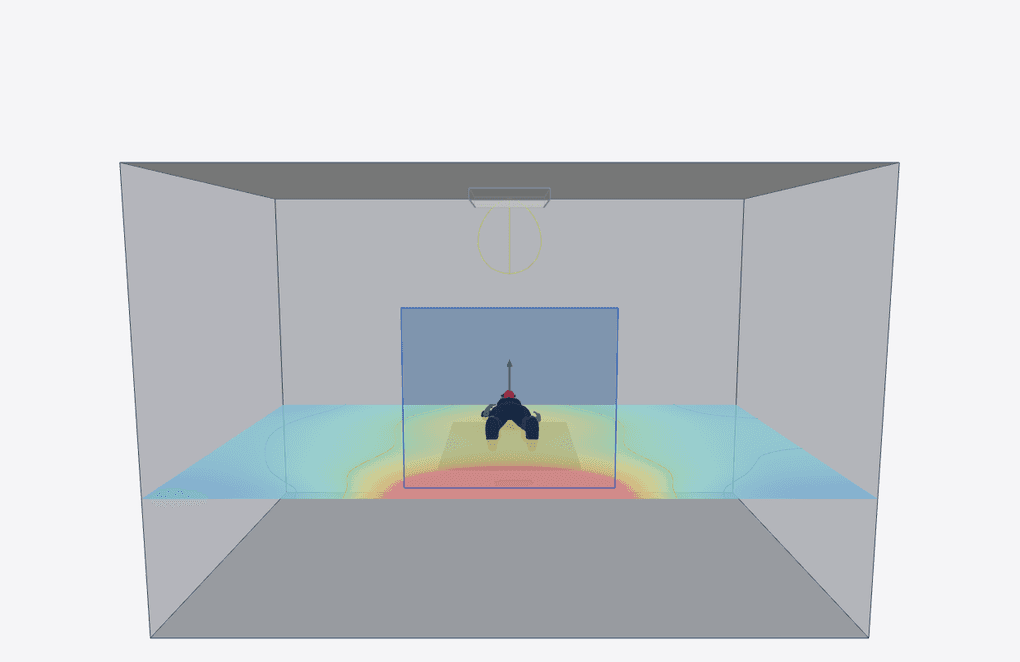
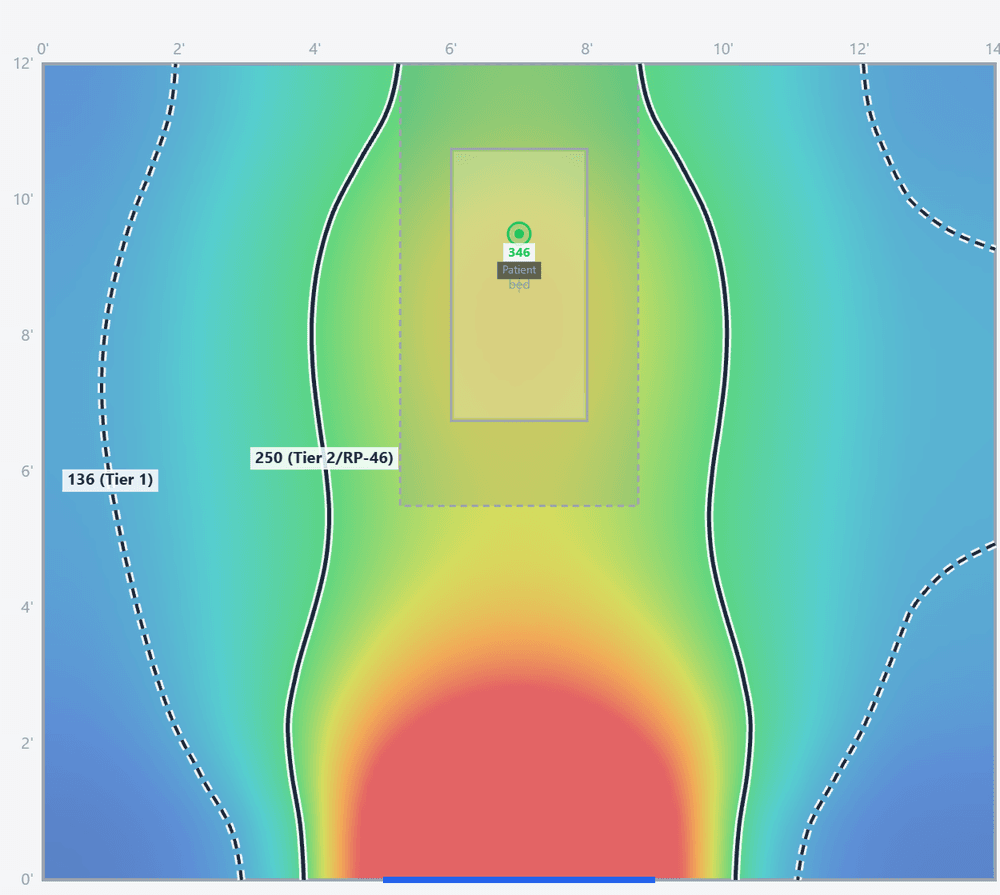
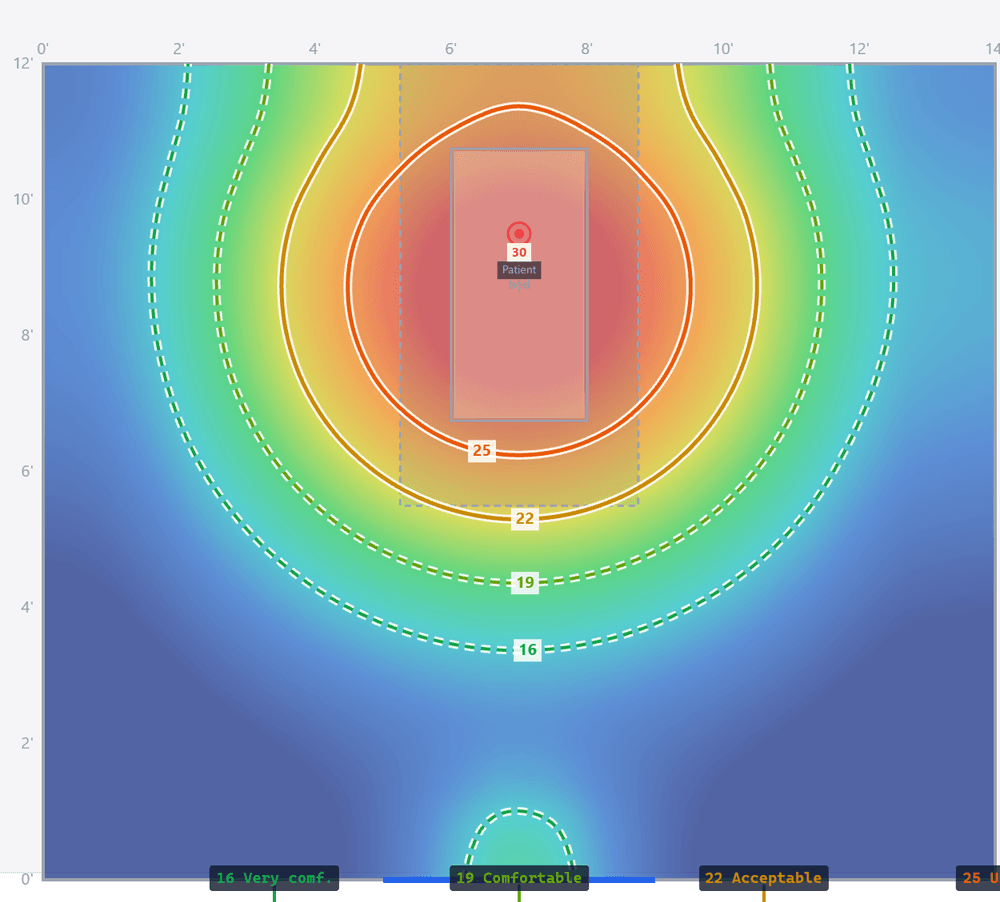
| Circadian (mel-EDI, up) | 280 (meets 250) |
| Glare (UGR, up) | 32.8 (intolerable) |
| Bed / Floor (fc) | 47 / 22.3 |
| Exam readiness | 47 fc, but 3500 K / CRI ~80 |
| Color rendering | CRI ~80 |
| Tunable scenes | No (fixed 3500 K) |
2Ceiling Circadian Sky panel (larger 2x4)867 mel-EDI · UGR 33.6 · intolerable overhead glare
A 2x4 Circadian Sky panel recessed in the ceiling over the bed.
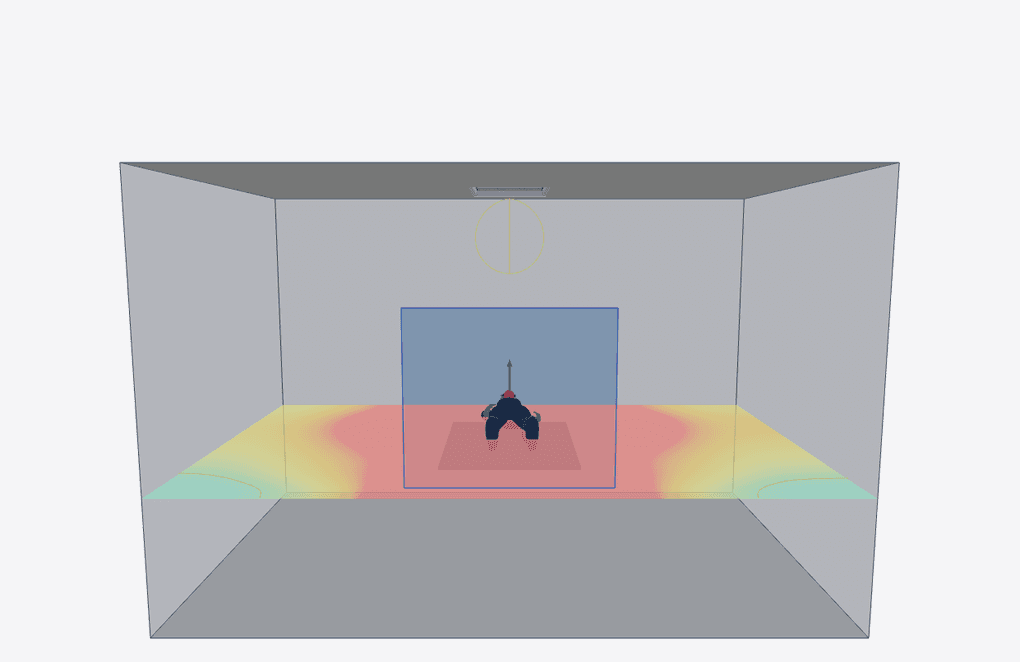
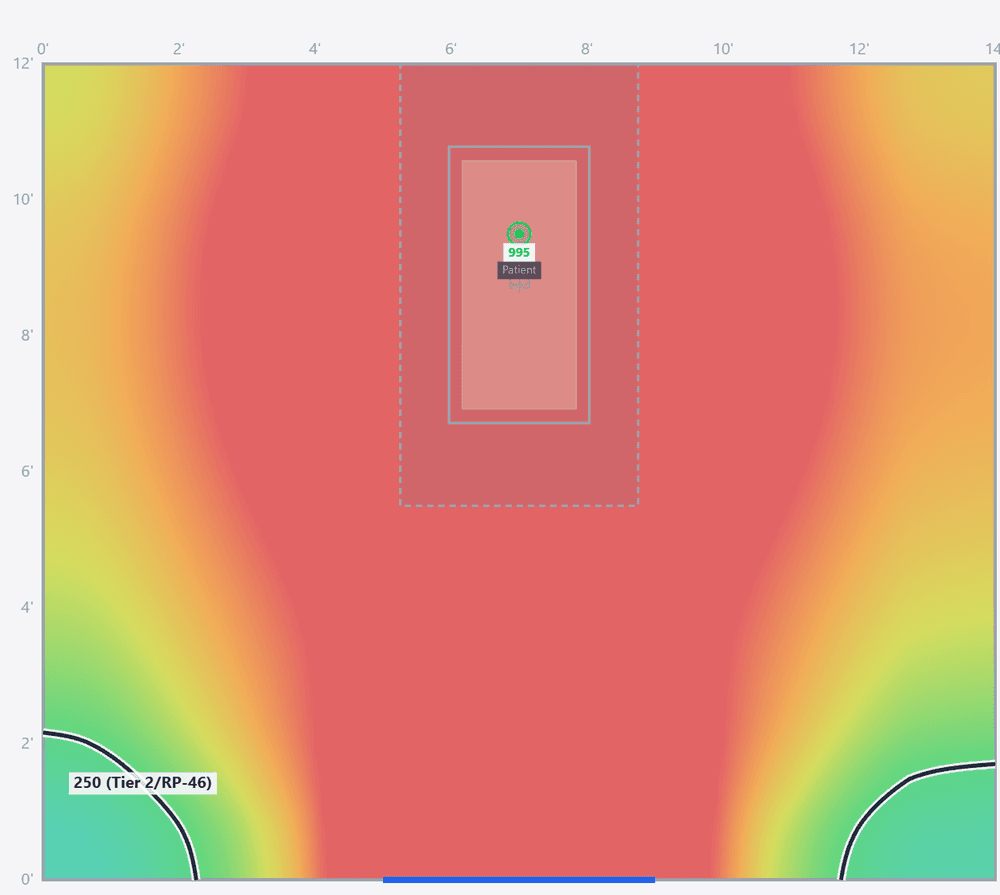
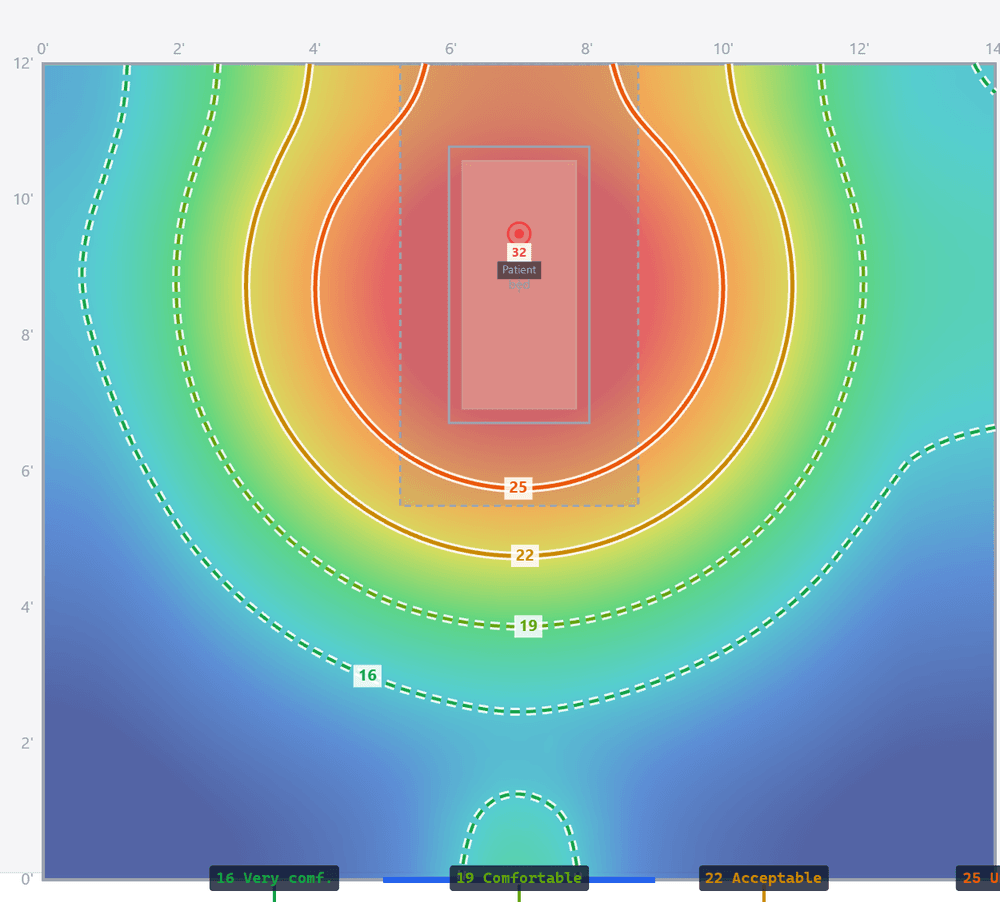
| Circadian (mel-EDI, up) | 867 (far over 250) |
| Glare (UGR, up) | 33.6 (intolerable) |
| Bed / Floor (fc) | 58 / 28.6 |
| Exam max (fc @5000 K) | 70 |
| Panel luminance | 4,290 cd/m² |
| Circadian Sky area | 8 sq ft |
3Circadian Sky behind the bed (headwall)513 mel-EDI · UGR 19.7 · acceptable, but under-doses sitting up
A 2x4 Circadian Sky panel wall-mounted high behind the bed, out of the upward gaze.
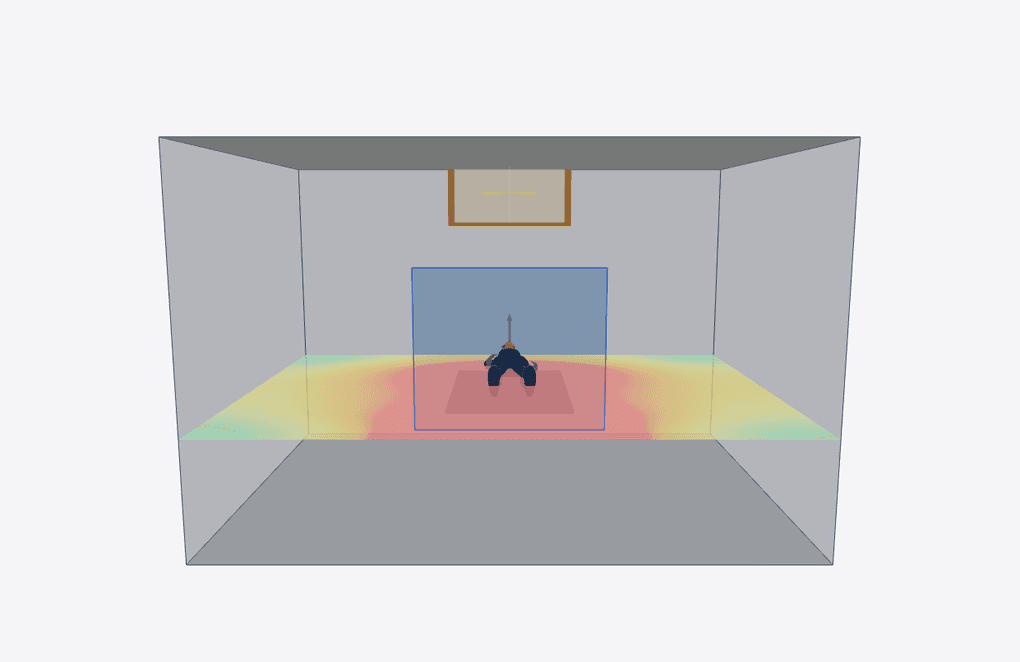
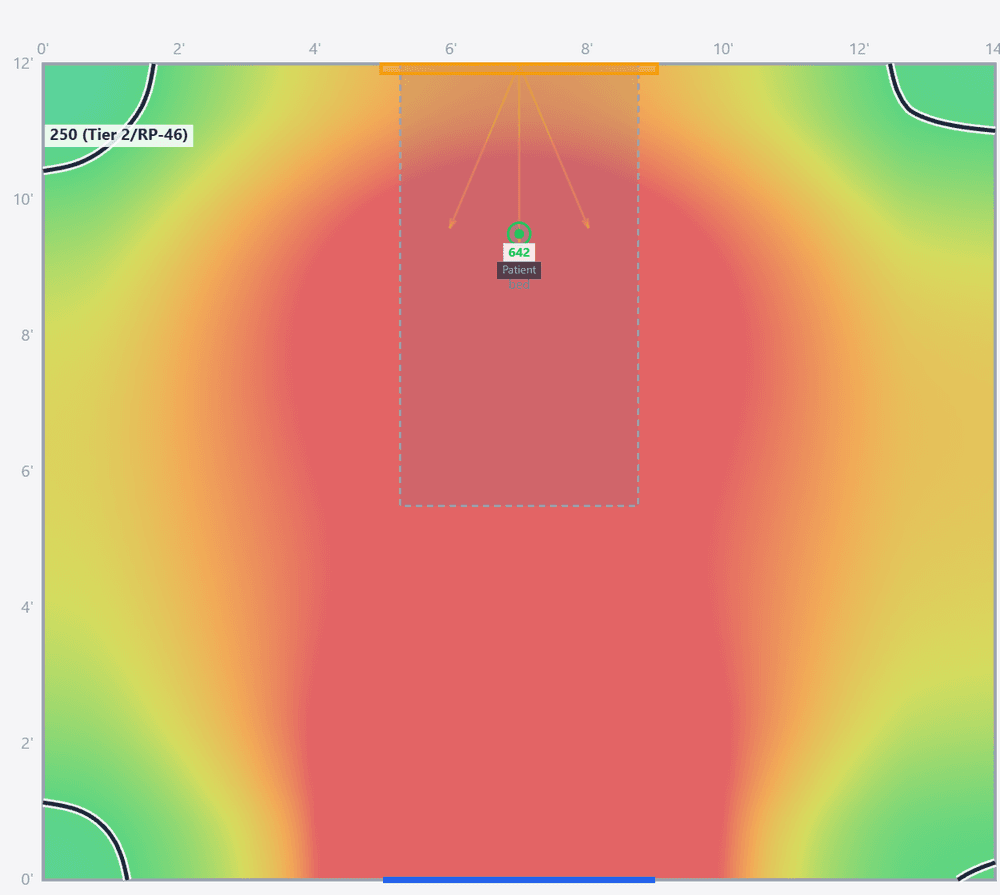
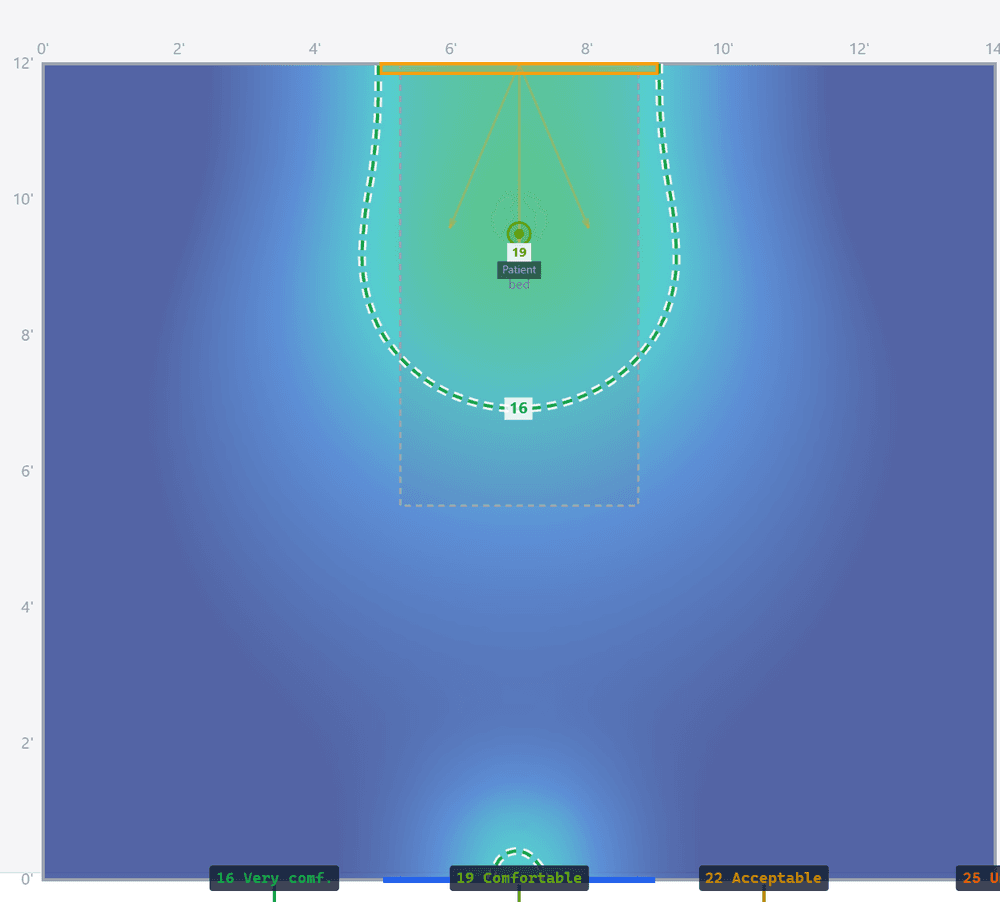
| Circadian (mel-EDI, up) | 513 (over 250) |
| Glare (UGR, up) | 19.7 (under the 22 room limit) |
| Bed / Floor (fc) | 34.3 / 20.7 |
| Exam max (fc @5000 K) | 42 |
| Panel luminance | 1,480 cd/m² (right at the cap) |
| Circadian Sky area | 8 sq ft |
4Cove plus headwall panel (best for a flat patient)365 mel-EDI · UGR 11.7 · best when flat, dose fades sitting up
A warm 3000 K LED strip hidden in a cove along two walls turns the ceiling into a soft, calming sky, paired with a dimmed Circadian Sky panel behind the bed to carry the circadian dose.
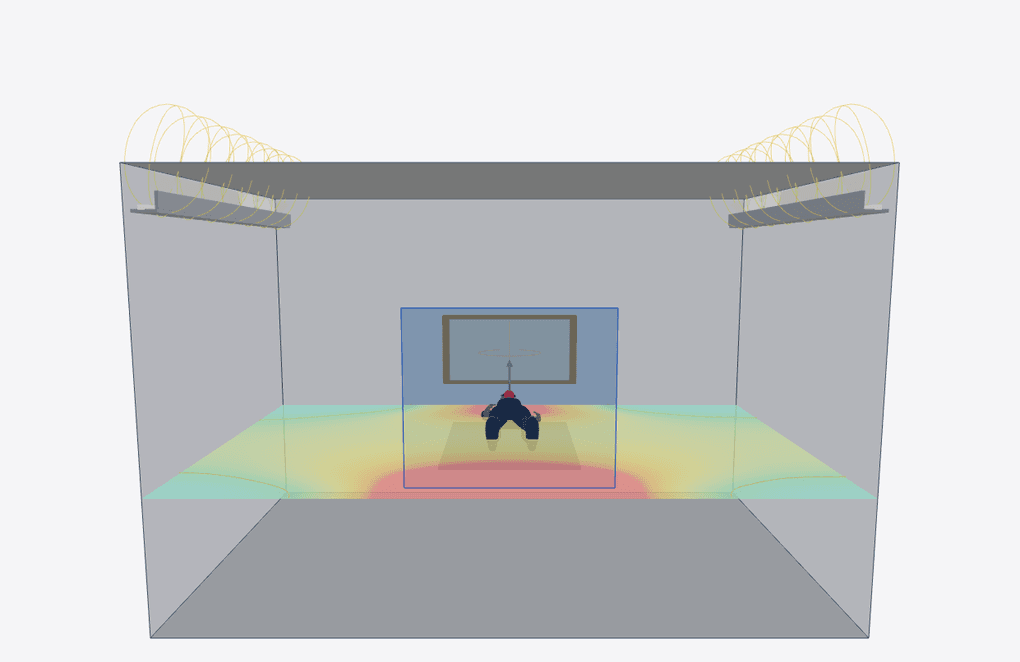
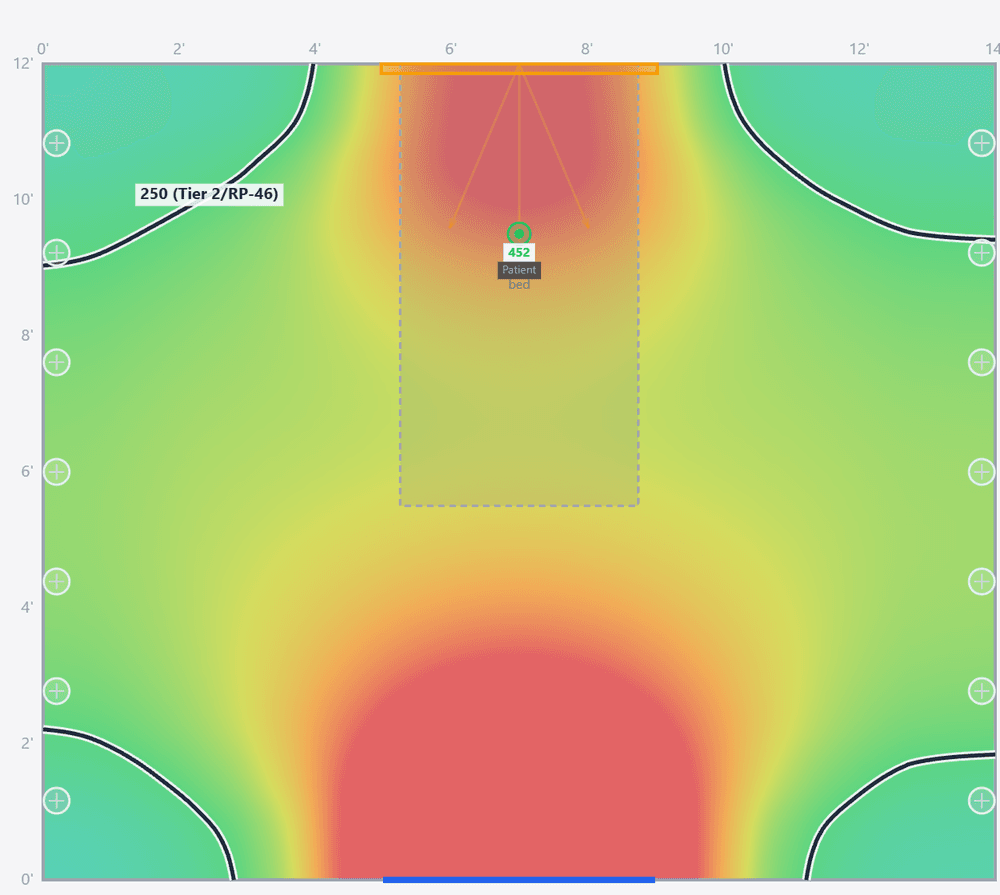
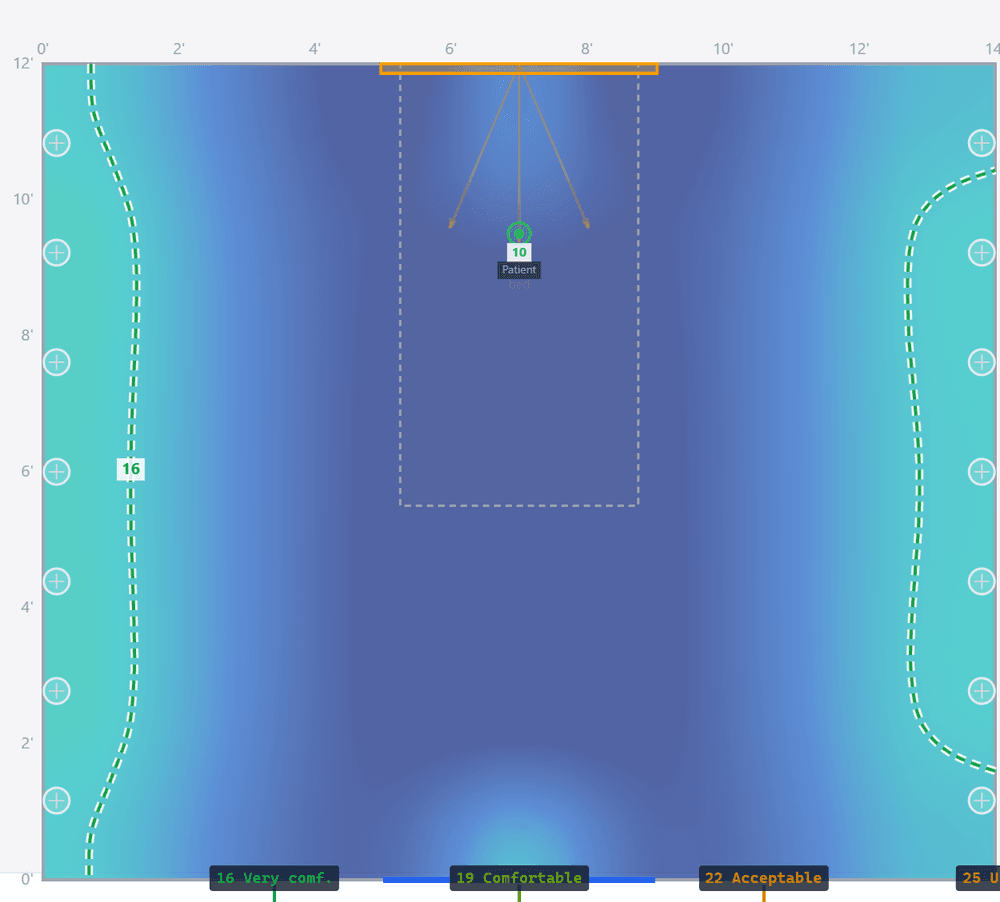
| Circadian (mel-EDI, up) | 365 (meets 250) |
| Glare (UGR, up) | 11.7 (very comfortable) |
| Bed / Floor (fc) | 29.4 / 19.4 |
| Exam max (fc @5000 K) | 112 |
| Ceiling luminance | ~115 cd/m² (soft, within cap) |
| Fixtures | Cove strip (2 walls) + dimmed headwall panel |
5Circadian Sky in the side wall277 mel-EDI · UGR 11.6 · meets the dose flat, collapses as the bed rises
A 2x4 Circadian Sky panel on the wall beside the bed, instead of behind the head, the wall-mount variant.
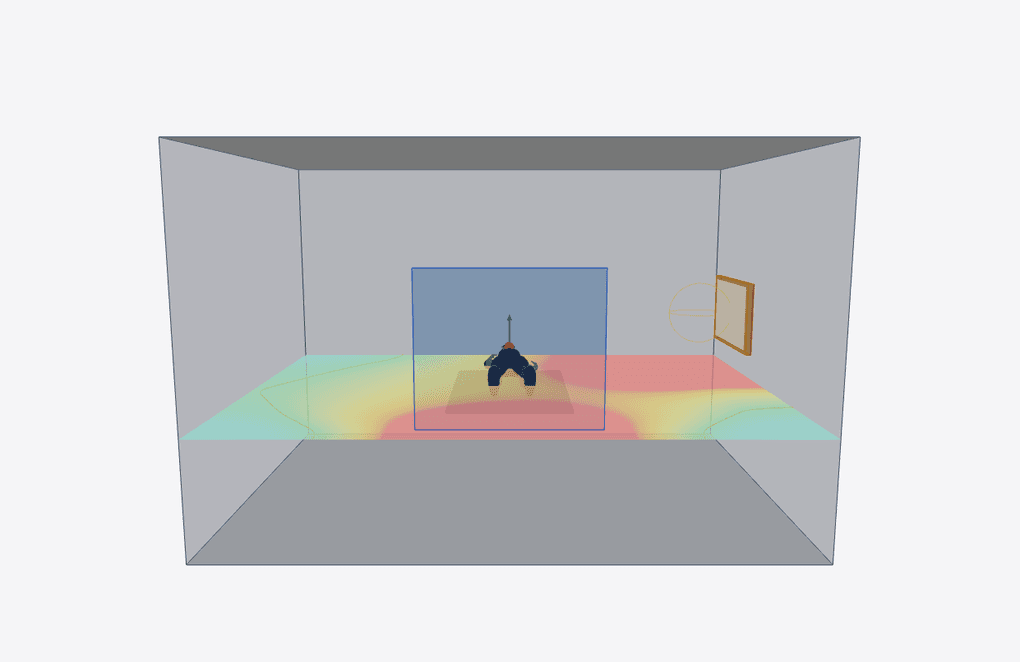
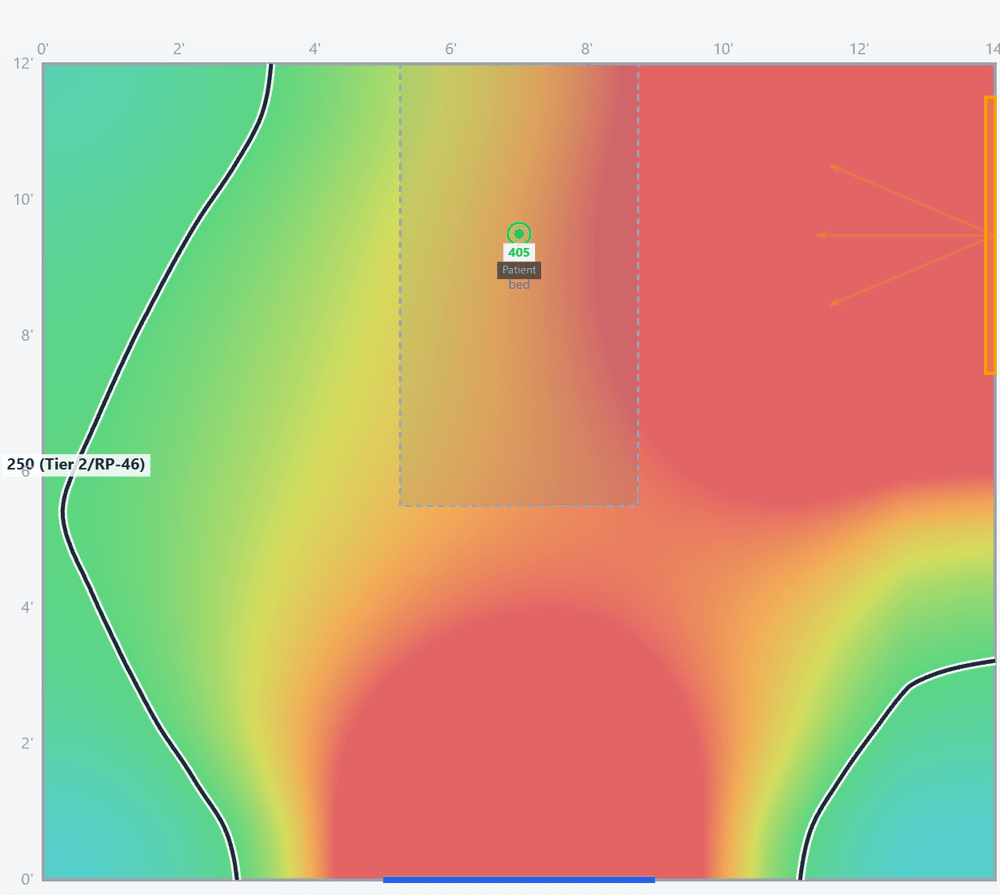
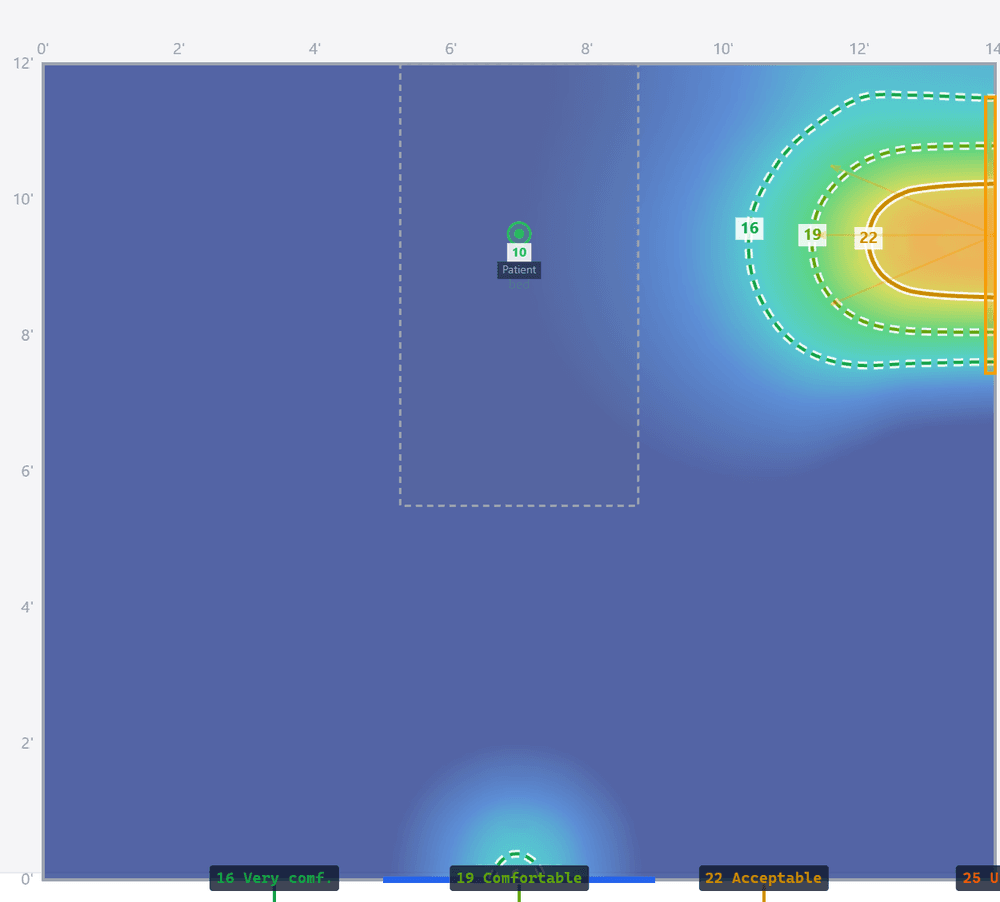
| Circadian (mel-EDI, up) | 277 (meets 250) |
| Glare (UGR, up) | 11.6 (very comfortable) |
| Bed / Floor (fc) | 18.5 / 18.5 |
| Exam max (fc @5000 K) | 22 |
| Dose when sitting up | Collapses to 86 mel-EDI |
| Circadian Sky area | 8 sq ft |
6Cove + headwall + overbed panel (the recommended design)444 mel-EDI · UGR 18.4 · holds the target in every bed position
Three sources, each covering one job: a warm cove for comfort, a headwall panel for the supine dose, and a 2x2 over the foot for the sitting dose. The only design that holds in every bed position.
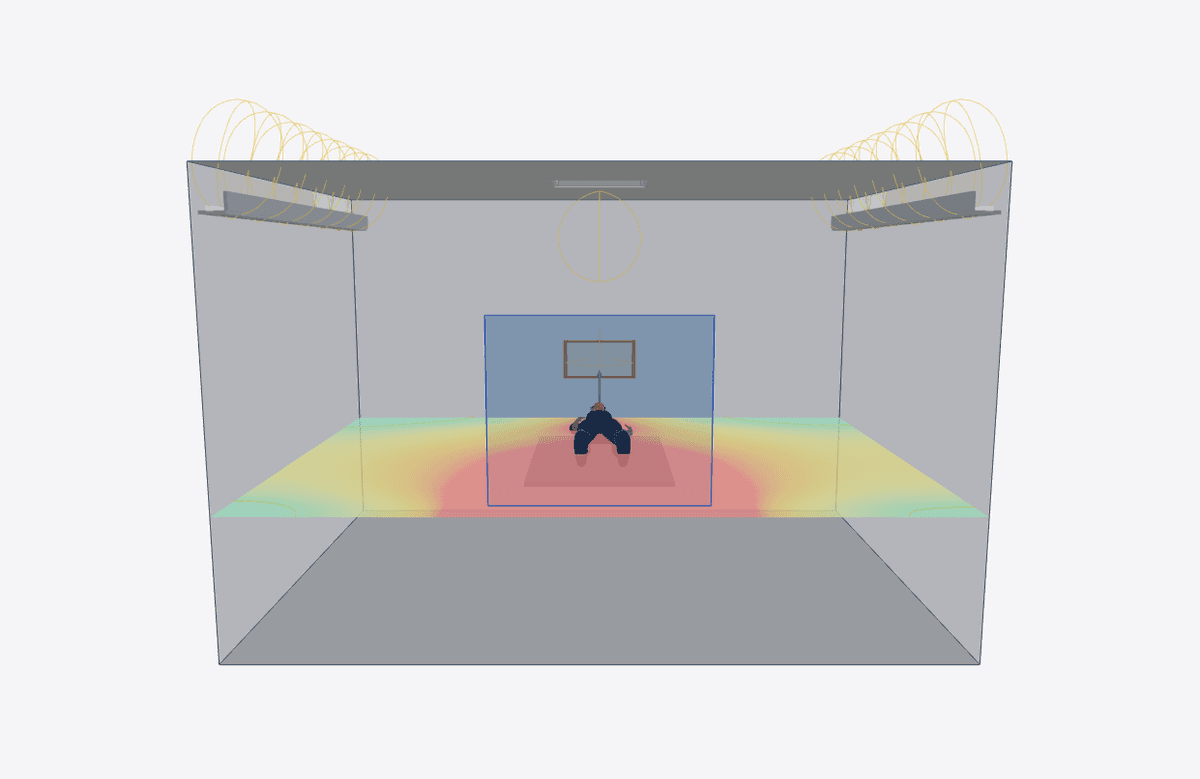
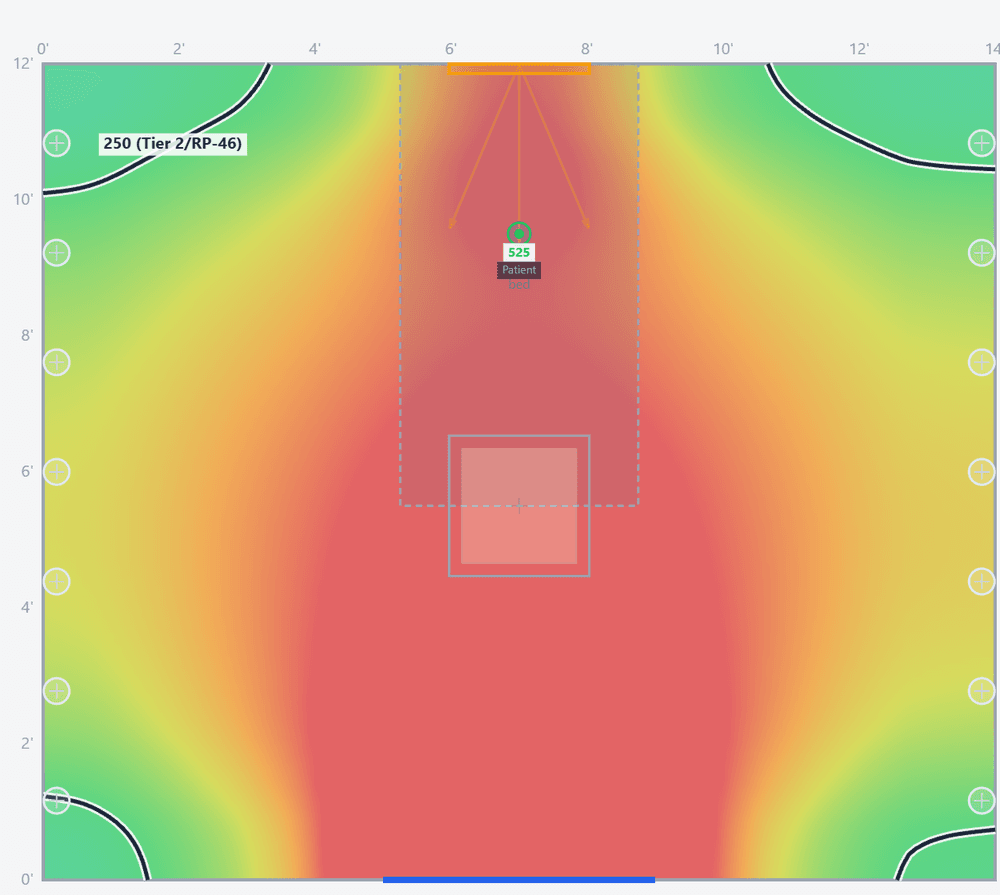
| Circadian (mel-EDI, up) | 444 (meets 250) |
| Glare (UGR, up) | 18.4 (comfortable) |
| Bed / Floor (fc) | 36.1 / 28.8 |
| Exam max (fc @5000 K) | 60 |
| Holds sitting up | 271 mel-EDI / UGR 15 (the only one) |
Reading the comparison
The full side-by-side table, plus why position beats brightness for glare, how the two illuminance jobs resolve, and why the exam wants 5000 K.
| Approach | mel-EDI (up) | UGR (up) | Bed fc | Floor fc | Luminance |
|---|---|---|---|---|---|
| 1. Conventional troffer | 280 | 32.8 | 47 | 22.3 | 2,964 |
| 2. Ceiling panel | 867 | 33.6 | 58 | 28.6 | 4,290 |
| 3. Headwall (behind bed) | 513 | 19.7 | 34.3 | 20.7 | 1,480 |
| 4. Cove + headwall | 365 | 11.7 | 29.4 | 19.4 | 115 |
| 5. Side wall (beside bed) | 277 | 11.6 | 18.5 | 18.5 | 4,290 |
| 6. Cove + two panels (recommended) | 444 | 18.4 | 36.1 | 28.8 | 115 |
The pattern is clear once you evaluate glare the way the patient sees it. Every design reaches the 250 mel-EDI circadian target for a patient lying flat, but note what it takes: the comfortable cove gets there only once it is paired with a dimmed headwall panel, because a warm cove strip is chosen for calm ambiance, not melanopic punch, so the dose falls to the panel. Circadian light is achievable; the hard part is delivering it without glare. That is what separates the options: the two overhead approaches both land in the intolerable band looking up, while the mounts that move the source out of the direct gaze, the headwall, the side wall, the cove-plus-headwall hybrid, and the recommended multi-source design, all sit at or under the 22 room limit. Position beats brightness.
Why the cove never works alone. A cove strip lights the eye only after its light bounces off the ceiling, and that indirect path is too weak to carry the circadian dose by itself. Even a cool 6500 K cove driven to a strong 600 lm/ft reaches just 177 mel-EDI at the supine eye (800 lm/ft tops out around 237, still short of 250); a warm 3500 K strip, with far less melanopic content per lumen, manages only about 131 even at 800 lm/ft. Open the 6500 K cove and check for yourself (like every model here it opens with the worst-case window; delete the window in the tool to isolate the cove). This is why every design here pairs the cove with a Circadian Sky panel: the panel carries the dose directly, in the blue-rich spectrum that delivers it at low luminance. And once the panel does that work, the cove’s colour becomes a free choice. A warm 3500 K or a cool 6500 K strip both clear 250 mel-EDI in the pairing (371 and 408), so you pick the cove CCT for the mood you want, warm and residential or crisp and daylight-like, without changing the circadian result. That is the flexibility of splitting the two jobs: the panel owns the dose, the cove owns the ambiance.
The two illuminance jobs resolve differently. Navigation is covered by nearly everything: the designs keep the floor at roughly 18 to 29 fc by day, above the ~10 fc general level, and any of them dims to the 0.4 fc night-observation minimum for safe wayfinding after dark. The 50 fc exam is where the CCT matters. At the daytime setting (40000 K, dimmed for comfort) the bed sits below exam brightness, but an exam is brief and colour-critical, so you tune the panels to ~5000 K(near-peak light output and CRI 97) and turn them up. Each card's exam maxrow is the bed illuminance in that setting. It splits the designs cleanly: the cove-plus-headwall hybrid reaches 112 fc and the multi-source design 60 fc, both past the 50 fc minimum, so they double as their own exam light. The headwall alone (42 fc) and the side-wall panel (22 fc) cannot, too little of their light lands on the patient, so they still need a dedicated bedside exam light; the overhead options land at 47 to 70 fc, but only as the glary sources we are avoiding. A single fixed troffer, stuck at 3500 K, can offer neither the circadian day nor a warm night.
Why 5000 K for the exam? An examination is a colour-critical task: clinicians read skin and tissue colour for jaundice (yellow), cyanosis (blue), pallor, and circulation, so the light must render colour faithfully. That calls for a high colour-rendering source, CRI Ra ≥ 90 with strong deep-red R9, at a near-daylight colour temperature, the reference white for judging colour, which is why healthcare guidance points exam and procedure areas to roughly 4000 to 5000 K.[5][9] The Circadian Sky's colour rendering peaks right there, CRI 97.5 with R9 98 at 5000 K, and its light output peaks near 5000 K too, so that setting is at once the most colour-accurate and the brightest, ideal for the brief exam. Some jurisdictions go further and require a low Cyanosis Observation Index (COI ≤ 3.3) so blue-tinged skin is not masked, which likewise constrains the exam spectrum to a daylight-like white with enough deep blue.[10] This is a second way the fixed 3500 K troffer fails the exam: even setting brightness aside, it is stuck at 3500 K with CRI around 80, below the 4000-5000 K, CRI-90 clinical bar, so it renders skin tone poorly no matter how far you turn it up. A tunable Circadian Sky simply shifts to 5000 K for the exam and back to its circadian setting after, colour-accurate when it must be, blue-rich the rest of the day.
Now add a window, even a terrible oneBarely matters lying flat · sitting up the patient faces the glass, and the window alone delivers most of the dose, at the price of borderline glare
The comparison above is deliberately electric-only: it is the light you can guarantee. But most patient rooms have a window, so we re-ran all six designs with the worst window regulations allow: a 4 x 3.4 ft opening, 13.6 sq ft of glazing, right at the FGI minimum of 8 percent of the floor area for this room, with a 3 ft sill, clear double glazing, and the glass a full 10 ft from the patient's pillow, under the darkest big-city daytime sky in our set, Seattle on an overcast December 21, at its best hour (noon). On its own, that window delivers 71 mel-EDI to the flat patient, 163 at 45°, and 242 sitting up, rising as the bed rises, because the raising gaze rotates toward the glass. Every "Open this model in CircadianLab" link in this article now includes exactly this window and sky, so what you open is the realistic room; the electric-only figures in the cards are what remains if you delete the window in the tool.
| Approach | Flat: electric → + window | Sitting: electric → + window | Sitting UGR w/ window |
|---|---|---|---|
| 1. Troffer | 280 → 346 | 43 → 280 | 23.3 |
| 2. Ceiling panel | 867 → 995 | 133 → 423 | 22.7 |
| 3. Headwall | 513 → 642 | 110 → 400 | 21.0 |
| 4. Cove + headwall | 365 → 452 | 79 → 335 | 22.2 |
| 5. Side wall | 277 → 405 | 86 → 376 | 22.4 |
| 6. Cove + two panels | 444 → 525 | 271 → 521 | 22.0 |
| Window alone, no fixtures | 71 | 242 | 25.6 |
mel-EDI at the patient's eye, lying flat and sitting up, for each design without and with the worst-case window. Green meets 250 mel-EDI (or UGR under 22).
Three observations. Lying flat, the window barely matters: it adds 66 to 129 mel-EDI, low in the supine patient's peripheral field, and it even improves the flat glare readings slightly by brightening the background the eye adapts to. The overhead options stay firmly intolerable (UGR 30 to 32), so no verdict changes. Sitting up, the window changes everything: the raised gaze points straight at the glass, the window alone delivers 242 of the 250 target, and with any of the six designs on top, the dose now holds in every bed position ( open the headwall design sitting up with this window). But the same view makes the window the room's dominant glare source: by itself it reads UGR 25.6 sitting up, past the comfort limit, the familiar experience of facing a bright gray sky from a hospital bed. The electric layers soften it by brightening the room around it, yet every design still lands between 21 and 23.3 sitting up, and only the headwall stays clearly under the UGR 22 line. A small window under a bright sky is a harsh little patch; glare control at the glass (a light shade or film) trades away exactly the dose it just delivered.
Why not just design around the window, then? Because the rescue is conditional and the failure is not: those sitting-up numbers are the best hour of that overcast day, and at 8 am, or behind a drawn shade or privacy curtain, the same window delivers almost nothing while the electric numbers hold. Take the window as margin, not as the plan: the electric layer still has to clear the target on its own, which is what the comparison above measures and why option 6 remains the recommendation.
Bright by day, dark by night #
A fair question follows from all of this: if a patient lying flat is often resting or asleep, do you even want high mel-EDI in that position? The answer is that circadian light is a time target, not a posture one: bright through the waking day, near-dark at night, whatever the bed angle.[1] Hospitals are chronically under-lit during the day, and that daytime dimness, as much as nighttime brightness, is what degrades patients' sleep and circadian rhythm; brighter, blue-rich daytime light has been associated with longer, more efficient sleep, better mood, and less delirium, itself tied to circadian disruption in a large share of ICU patients.[7][8] The same light at night suppresses melatonin and fragments sleep, and excess nighttime light is a well-documented hospital problem,[1] so after dark the room should be dark and warm.
That is why a good scheme must be tunable and scheduled, not fixed. The Circadian Sky panels deliver the blue-rich dose through the day, doing more when the patient is sitting up and engaged, then ramp warm and dim in the evening and go near-dark at night, while the warm 3000 K cove becomes the gentle night light for safe movement without wrecking sleep. Meeting the target "in every bed position" is a daytime goal; after dark the very same fixtures reverse course. Put plainly: chase the dose when the patient is awake, whatever the bed angle, and let it go when they sleep.
What about daylight? #
US hospitals are federally required to give every patient sleeping room an outside window or outside door,[11] so most have one, and daylight is the reference spectrum the circadian metric is defined against: one lux of daylight delivers roughly a full melanopic lux, where a warm-white LED delivers half that.[26] So can the window do the circadian job by itself? We modeled a generous 8 x 5 ft window in the same room, with the supine patient 10 ft from the glass, across the ten sunniest large cities in America plus Seattle, at both solstices, hour by hour, clear and overcast, for all four window orientations. The short answer: even in Phoenix, daylight covers the 250 mel-EDI daytime dose only within a few hours of midday, through reasonably clear glass, on the right facade, with the blinds open. It is a wonderful bonus layer, and a bad primary plan.
Method: CircadianLab's daylight engine (solar position, clear/overcast sky, glazing transmission, and interreflection solved together with the room). Window at the foot of the bed, 2.5 ft sill, clear double glazing (62% visible transmittance), no obstructions outside. All figures are mel-EDI at the patient's eye, lying flat, looking up. Open either model below and change the city, date, time, sky, or glazing yourself.
Phoenix: south window, Dec 21, noon, clear
653 mel-EDI at the eye (target 250) · UGR 13.8 · whole room over target
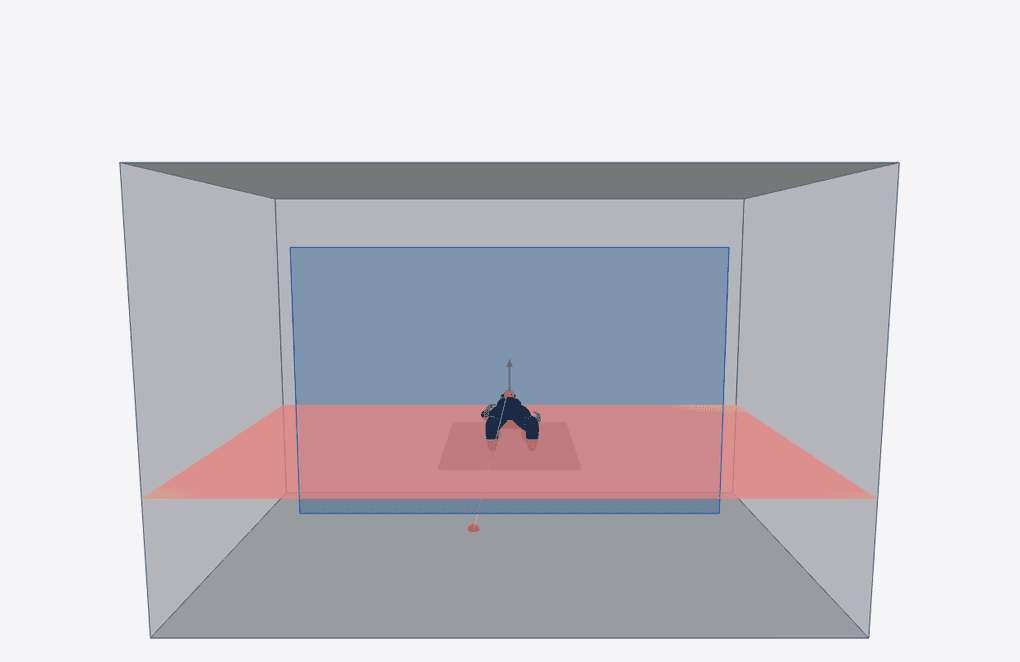
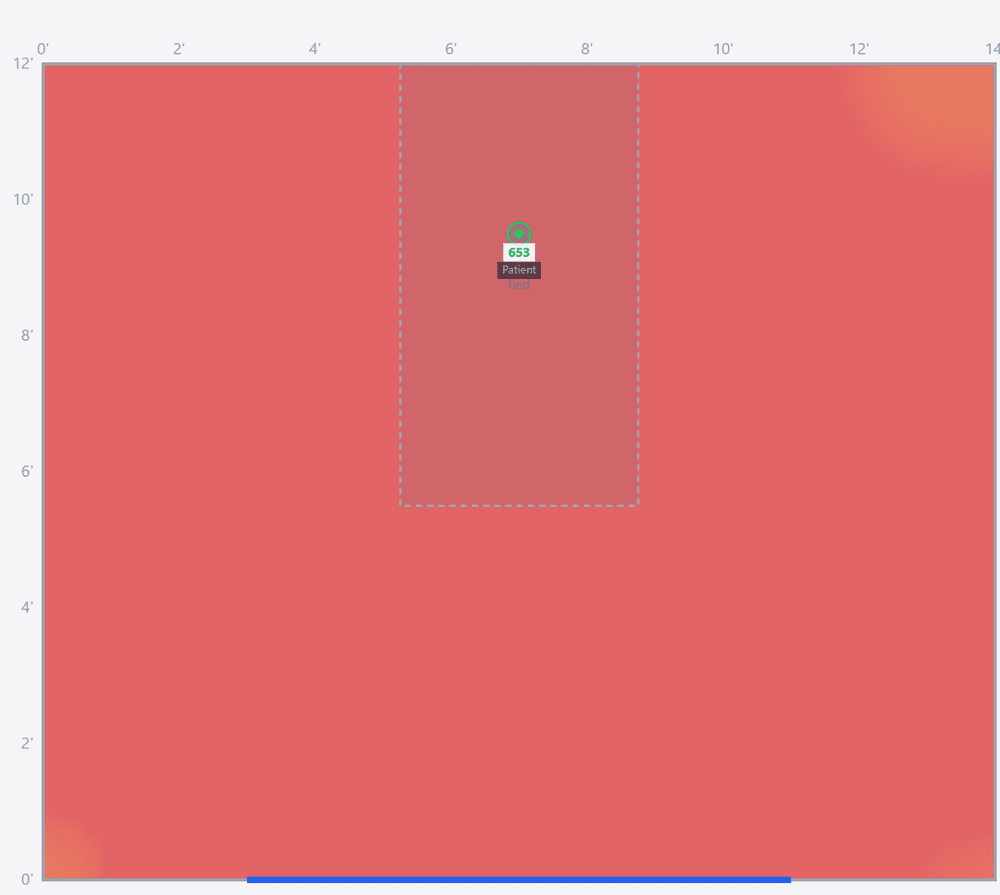
Seattle: north window, Dec 21, noon, overcast
207 mel-EDI at the eye · the 250 zone ends about 6 ft from the glass, short of the bed
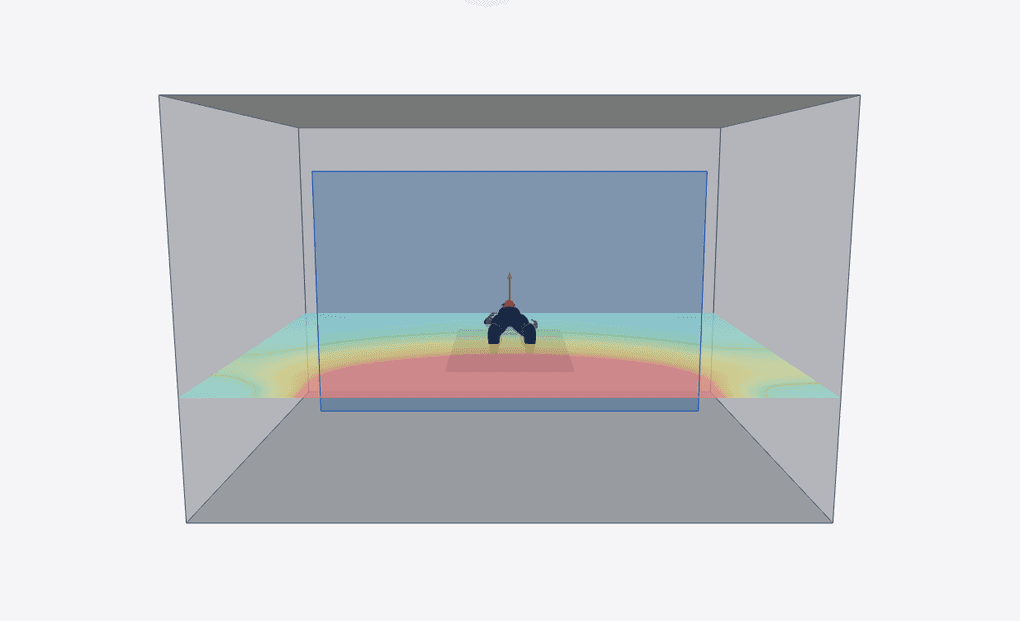
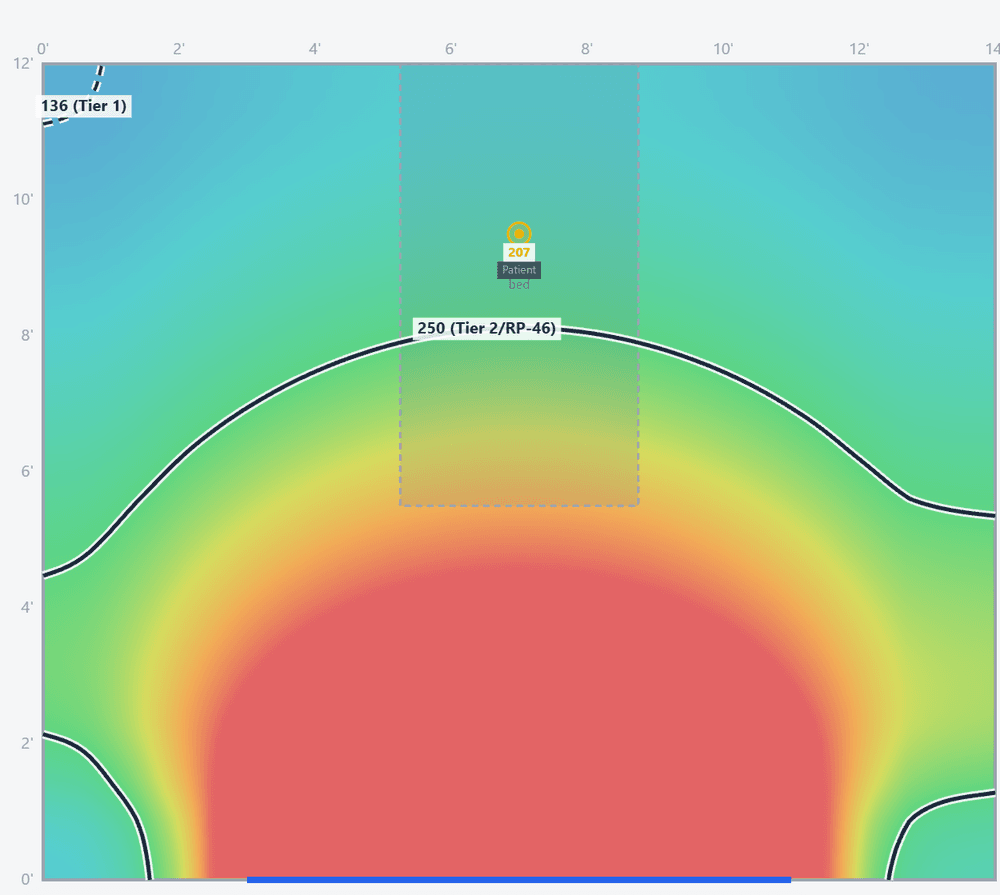
The same room, window, and patient. At its winter best, daylight floods the Phoenix room to more than twice the target; at Seattle's winter best hour the dose dies before it reaches the bed, and this is the good case, with the blinds fully open and nothing built across the street.
Windows are required by code, but a window is not a guaranteeFederally mandated in every patient sleeping room · yet 37-42% of studied ICU stays were windowless
There is no national count of how many US patient rooms have windows, but the requirement is close to universal. Medicare's Conditions of Participation require an outside window (or outside door) in every patient sleeping room, with a sill no higher than 36 inches in new construction,[11] and the FGI Guidelines, the design code most states adopt for hospitals, require patient rooms to be "provided with natural light by means of a window to the outside," with glazing of at least 8 percent of the floor area.[12] Modern med-surg rooms, in short, have windows.
The gaps are in critical care and older building stock, which codes grandfather in. In a 2024 survey of 30 US pediatric ICUs, one unit in five still had windowless rooms.[13] At a major academic neuro-ICU, 42 percent of a decade of subarachnoid-hemorrhage patients were treated in windowless rooms,[14] and at Massachusetts General Hospital, 37 percent of 3,527 ICU admissions (2020-2023) were to windowless rooms.[15]
Why it matters is one of the oldest findings in evidence-based design: surgical patients with a window view of trees left nearly a day sooner and took fewer strong analgesics than matched patients facing a wall,[16] depressed inpatients in sunny rooms were discharged 15 percent sooner (and MI patients in sunny rooms fared better),[17] spinal-surgery patients on the bright side of the ward used 22 percent less analgesic medication per hour,[18] and two classic ICU studies found roughly twice the delirium in windowless units.[19] Not every study agrees (the neuro-ICU cohort found no outcome difference, and the MGH study's windowed rooms actually had more delirium in a retrospective design the authors caution is confounded[14][15]), but the weight of the evidence, and every design guideline, favors the window.
The glass takes its cut before any daylight gets inHospital glazing passes 45-70% of daylight · tints and films can cut it to 10-35% · closed shades to nearly zero
Exterior daylight is enormous (a clear sunny day is on the order of 100,000 lux, overcast 5,000 to 20,000), which is why even a fraction of it can carry a room. But every layer between sky and eye takes a share, and the shares multiply. Clear double glazing passes about 78-82 percent; the solar-control low-E units on modern hospital curtain walls pass 51-70 percent (Vitro's widely used Solarban 60/70/90 line spans exactly that range[21]); tinted (bronze/gray/green) substrates commonly land between 10 and 45 percent.[21] Retrofit window films, added later for heat and glare, run 15-50 percent,[22] and roller shades with a 1-5 percent openness fabric block 95-99 percent of what reaches them. A closed hospital privacy curtain is effectively opaque.
Our model's 62 percent double glazing is therefore a friendly assumption, and because through-window light scales almost linearly with transmittance, you can re-scale every number in this section in your head:
| Glazing / attenuation | Daylight kept | Phoenix, clear winter noon (653) | Seattle, overcast winter noon (207) |
|---|---|---|---|
| Clear double glazing (modeled) | 62% | 653 | 207 |
| Solar-control low-E (Solarban 70 class) | ~64% | 674 | 214 |
| Solar-control low-E (Solarban 90 class) | ~51% | 537 | 170 |
| Tinted solar glass | ~35% | 369 | 117 |
| 35% film on double glazing | ~22% | 229 | 73 |
| 15% film on double glazing | ~9% | 98 | 31 |
| 3% openness roller shade, down | ~2% | 21 | 7 |
The pattern to notice: any tint below roughly 50 percent puts even the best-case sky at risk, and the moment a shade comes down for glare (see the orientation card for why it will), daylight's circadian contribution is essentially gone. Tint and shading are chosen for heat and comfort by facade engineers who are not calculating mel-EDI; if a circadian daylight strategy is intended, the glazing schedule has to be part of the lighting design.
Orientation: what north, east, south, and west actually changeSouth is the only facade that peaks in winter · east/west each own half a day · north never reaches the target from fall to spring
Under an overcast sky, orientation barely matters: the light is diffuse, and all four facades see the same gray dome. Orientation is a clear-sky variable, and on clear days the four facades behave completely differently. Peak usable mel-EDI at the eye (excluding direct-sun-in-the-eyes moments), by facade:
| City | South (winter noon) | East (summer morning) | West (summer afternoon) | North (summer midday) |
|---|---|---|---|---|
| Phoenix | 653 | 599 | 551 | 401 |
| Las Vegas | 583 | 692 | 552 | 393 |
| Tucson | 627 | 618 | 549 | 404 |
| El Paso | 599 | 579 | 645 | 397 |
| Fresno | 546 | 618 | 623 | 386 |
| Sacramento | 640 | 600 | 637 | 385 |
| Albuquerque | 589 | 576 | 644 | 392 |
| Los Angeles | 614 | 637 | 610 | 392 |
| Miami | 578 | 553 | 682 | 407 |
| Denver | 603 | 636 | 620 | 380 |
| Seattle | 501 (summer) | 543 | 633 | 359 |
South is the healthcare facade: the only orientation whose best hours come in winter (the low sun reaches deep into the room), holding 250 from roughly mid-morning to mid-afternoon on clear winter days in every sunny city. East and west each own half a day, mornings or afternoons, and fail the other half; their peaks are summer numbers. North gets the least direct sun, only low-angle beams on early summer mornings and evenings and none in the middle of the day, which makes it the gentlest light in the table but also the weakest: it clears 250 only around summer midday and never in winter, anywhere, not even in Phoenix (winter best: 175).
East and west also carry the failure mode that undoes real-world daylight strategies: a low sun square in the patient's face. At 8 am on a clear June morning, an east window puts 8,000 to 14,700 mel-EDI on the supine eye at UGR 57 to 62, far beyond intolerable, with the same show on west facades before sunset and on south facades in mid-winter at low latitudes ( open Seattle's clear December noon and see the beam land on the pillow). A patient who cannot move away from it, or a nurse who walks in on it, closes the blinds, and the room drops from thousands of mel-EDI to essentially zero for the rest of the day. Glare control and circadian dose come from the same piece of fabric, and glare wins.
The minimum north-facing window fails 365 days a year, everywhereExpected days per year daylight alone misses the dose · a generous south window fails 0-63 days in the sunny ten, 127 in Seattle
Putting the climate data and the room model together, we can estimate how many days a year daylight alone fails the daytime dose, defined the way WELL v2 shapes it: 250 mel-EDI at the patient's eye for at least four hours, beginning by noon.[2] For each city we simulated the room across the solar year under clear, intermediate, and overcast skies, then weighted each sky by the city's NOAA count of clear, partly cloudy, and cloudy days.[20]
Three lines, three lessons. The regulation-minimum window facing north fails every single day of the year in every city, Phoenix included: 13.6 sq ft of diffuse sky simply cannot push 250 mel-EDI ten feet to the pillow for four hours, ever. The same generous 8 x 5 ft window rotated from south to north gives up 100 to 200 days a year, which makes facade orientation the cheapest daylight decision a hospital planner controls. And even the best case, a big south window, still fails about a month of days in Phoenix (27, mostly overcast winter mornings), two months in Denver (63), and a third of the year in Seattle (127). There is no city and no code-compliant window for which daylight alone is a dependable circadian dose.
Method notes: supine patient, eye 10 ft from the glass, clear double glazing, blinds open all day, no exterior obstructions; partly cloudy days modeled as the CIE intermediate sky; cloudiness assumed uniform across seasons (most cities are cloudier in winter, so the true failure counts skew slightly higher); south-window clear-sky days counted as compliant even when part of the dose arrives as direct sun that would in practice force the blinds closed.
And that is the optimistic caseThe chart assumes clear glass, open blinds, and one bed near the window · real tint, shades, and room depth only subtract from it
The chart above is generous by construction: clear glazing, blinds open all day, a single bed close to the glass, nothing built across the street. Every real departure from that pushes the failure counts higher, not lower.
- Behind dark glazing: below roughly 50 percent transmittance the margins vanish, and a 15-35 percent solar film turns even Phoenix's best hours marginal.[21][22]
- Whenever the shade is down, which the orientation card shows is a matter of when, not if, on east, west, and winter-south exposures. The chart counts those clear-sky days as compliant; a patient who closes the blinds against the beam turns them into failures.
- Deeper in the room: our patient sits a friendly 10 ft from the window. Daylight's useful reach is roughly 1.5 to 2.5 times the window head height,[25] so a second bed, a deeper room, or the minimum window shrinks the dose fast. Simulation studies of hospital rooms reach the same conclusion, needing 30-40 percent of the whole facade glazed just to cover the room with a circadian-effective dose,[23] and field measurements in offices find the 250 mel-EDI target reliably met only near unobstructed windows.[24]
None of this is an argument against windows: the outcome evidence above is an argument for them, they deliver view, orientation to time of day, and free dose whenever conditions line up. It is an argument about what to size the electric layer for. Size it for the worst case, the November morning, the north-facing room, the drawn shade, and the second bed, so it clears 250 mel-EDI on its own with daylight arriving as a bonus on top. That is exactly the multi-source design in option 6, and why the daylight scene in CircadianLab adds window light on top of the electric solution rather than replacing it. Model your own facade, city, and glazing before trusting the window with the dose.
Model your own patient room
The comparison here is one room, one bed, and six layouts judged against these targets; your room, product spectra, and adopted standards may point to a different answer. That is what the editable models are for: open any of them in CircadianLab, set an occupant to the lying down posture, and switch the metric direction to Up (lying down) to see mel-EDI and glare the way the patient does. It is free, runs in your browser, and needs no login.
Sources #
- Brown TM, et al. Recommendations for daytime, evening, and nighttime indoor light exposure to best support physiology, sleep, and wakefulness in healthy adults. PLoS Biology, 2022. journals.plos.org
- International WELL Building Institute. WELL v2, Feature L03: Circadian Lighting Design. WELL states its tiers in equivalent melanopic lux, 150 EML (Tier 1) and 275 EML (Tier 2), measured at the eye over a four-hour window beginning by noon at the latest; in the mel-EDI units used here (CIE S 026, roughly EML × 0.906) those are about 136 and 250 mel-EDI. WELL is a voluntary building-certification framework, not a building code. standard.wellcertified.com
- ANSI/IES RP-46-25, Recommended Practice: Supporting the Physiological and Behavioral Effects of Lighting in Interior Daytime Environments. Illuminating Engineering Society. store.ies.org
- ANSI/IES RP-29-25, Recommended Practice: Lighting Hospital and Healthcare Facilities. Illuminating Engineering Society. A non-prescriptive Recommended Practice, binding only where a code, contract, or authority having jurisdiction adopts it. store.ies.org
- EN 12464-1, Light and lighting, Lighting of work places, Part 1: Indoor work places (healthcare tables: patient rooms, examination, CRI and UGR limits).
- Society of Light and Lighting (SLL), Lighting Guide 2: Lighting for Healthcare Premises (LG2). Maximum average luminaire luminance for patients viewing from bed: approx. 1,500 cd/m² surface-mounted, 1,000 cd/m² recessed.
- Giménez MC, et al. Patient room lighting influences on sleep, appraisal and mood in hospitalized people. Journal of Sleep Research, 2017. onlinelibrary.wiley.com
- The impact of dynamic lighting on sleep timing and duration for hospitalised patients; and reviews linking daytime bright light and reduced nighttime light to improved sleep and lower delirium in ICU patients. pmc.ncbi.nlm.nih.gov
- Color quality versus energy efficiency: a dual perspective on LED retrofits in healthcare examination rooms (examination / procedure areas call for ~4000-5000 K and CRI Ra ≥ 90). Applied Sciences, 2025. mdpi.com
- Cyanosis Observation Index (COI ≤ 3.3) for clinical observation areas, AS/NZS 1680.2.5; overview of CRI and COI in medical environments. luminusdevices.com
- 42 CFR §482.41(b)(9), Medicare Conditions of Participation: Physical Environment (outside window or outside door required in every patient sleeping room; 36-inch maximum sill in buildings constructed after July 5, 2016). law.cornell.edu
- FGI Guidelines for Design and Construction of Hospitals, §2.1-7.2.2.5 (patient rooms provided with natural light by means of a window to the outside; minimum glazing 8 percent of floor area). Facility Guidelines Institute. fgiguidelines.org
- Karam O, et al. Design of pediatric intensive care unit rooms: a national survey (80% of 30 surveyed US PICUs had windows in every room). Frontiers in Pediatrics, 2024. pmc.ncbi.nlm.nih.gov
- Wunsch H, et al. The effect of window rooms on critically ill patients with subarachnoid hemorrhage (42.3% of admissions to windowless rooms; no outcome difference). Critical Care, 2011. pmc.ncbi.nlm.nih.gov
- Windows in the ICU and postoperative delirium: a retrospective cohort study (37% of 3,527 ICU admissions to windowless rooms). Critical Care Medicine, 2025. pubmed.ncbi.nlm.nih.gov
- Ulrich RS. View through a window may influence recovery from surgery. Science, 1984. science.org
- Beauchemin KM, Hays P. Sunny hospital rooms expedite recovery from severe and refractory depressions. Journal of Affective Disorders, 1996. pubmed.ncbi.nlm.nih.gov; and Dying in the dark: sunshine, gender and outcomes in myocardial infarction. Journal of the Royal Society of Medicine, 1998. pubmed.ncbi.nlm.nih.gov
- Walch JM, et al. The effect of sunlight on postoperative analgesic medication use. Psychosomatic Medicine, 2005. pubmed.ncbi.nlm.nih.gov
- Wilson LM. Intensive care delirium: the effect of outside deprivation in a windowless unit. Archives of Internal Medicine, 1972; and Keep P, James J, Inman M. Windows in the intensive therapy unit. Anaesthesia, 1980. pubmed.ncbi.nlm.nih.gov
- NOAA NCEI Comparative Climatic Data: average percent of possible sunshine, clear and cloudy days, and sunshine hours by city (1961-1990 sunshine normals), as tabulated by Current Results. currentresults.com
- Vitro Architectural Glass, Solarban 60/70/90 performance data (visible light transmittance of solar-control low-E insulating glass units, clear substrates: approx. 70/64/51 percent; substantially lower on tinted substrates). vitroglazings.com
- Visible light transmission of architectural window films (common retrofit range 15-50 percent VLT). windowfilm.com
- Acosta I, Leslie RP, Figueiro MG. Analysis of circadian stimulus allowed by daylighting in hospital rooms. Lighting Research & Technology, 2017. healthdesign.org
- Ticleanu C, Flores-Villa L, Littlefair P, Howlett G. Assessing melanopic equivalent daylight illuminance in office spaces. Lighting Research & Technology, 2025. journals.sagepub.com
- Reinhart CF. A simulation-based review of the ubiquitous window-head-height to daylit zone depth rule of thumb. Building Simulation, 2005; LBNL, Tips for Daylighting with Windows, 1997. eta-publications.lbl.gov
- Schöllhorn I, et al. Melanopic and photopic characteristics of white LEDs: correlated colour temperature is not a suitable proxy for the biological potency of light (melanopic DER of common 2700-4000 K LEDs approx. 0.44-0.67; daylight D65 = 1.0 by definition, CIE S 026:2018). Scientific Reports, 2022. nature.com
Published by Innerscene on 2026-07-04