Maximizing EML While Managing Glare and Cost: A Practical Guide
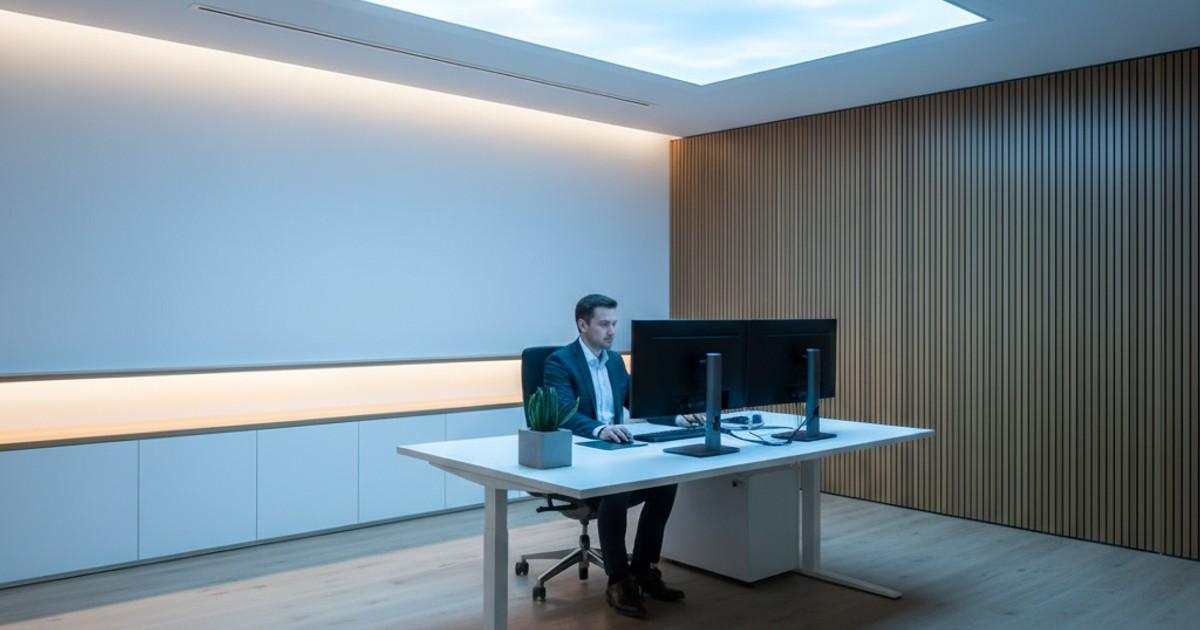
Delivering high Equivalent Melanopic Lux (EML) is essential for circadian lighting, but pushing brightness higher inevitably raises glare. Here are three ways to increase EML without blinding the occupants.
The EML–Glare Tension
The WELL Building Standard v2 (Feature L03) requires Equivalent Melanopic Lux (EML) of at least 150 (Tier 1) or 275 (Tier 2), measured at the vertical plane at eye level — the light that actually enters the occupant's retina and drives circadian responses.[1] At the same time, UGR (Unified Glare Rating) must stay at or below 22, and EN 12464-1 demands UGR ≤ 19 for typical office tasks.[2]
EML is calculated as:
where M/P Ratio is the melanopic-to-photopic ratio of the light source, defined by CIE S 026.[3] Meanwhile, UGR is governed by luminaire luminance:
Simply turning up the lights increases both EML and glare proportionally. To break this coupling, we need strategies that boost melanopic content without raising luminaire luminance.
Strategy 1: Use Higher Melanopic Spectrum Optimized Lighting
The M/P ratio increases steeply with correlated color temperature (CCT). A higher-CCT source delivers more melanopic content per photopic lux — which means you can hit the same EML target at a lower output level, reducing both luminaire luminance (Li in the UGR formula) and energy consumption.[3]
Circadian Sky's melanopic optimised spectrum dynamic CCT range spans 2,200 K to 200,000 K, controlled through built-in circadian scheduling (programming codes P0001 and P0002) or external control systems. By scheduling peak daytime CCTs at 6,500 K or higher, you take full advantage of the rising M/P ratio:
Practical Impact: Same EML, Less Glare
Since UGR depends on luminaire luminance, and a higher-CCT source needs less output to reach a given EML target, the resulting UGR drops automatically. The chart below shows what happens when a single CS22 ceiling-mounted fixture targets 275 EML (WELL v2 Tier 2) at different CCTs:
Key takeaway
Programming the circadian schedule to reach 6,500 K or higher during peak daytime hours is the single most effective way to satisfy both melanopic and glare requirements simultaneously — without adding fixtures or increasing cost. Circadian Sky's built-in scheduling codes (P0001/P0002) already do this automatically: CCT rises through the morning, peaks at ~10,000–40,000 K midday, then descends for evening.
How Circadian Sky's Recessed Trim Helps
Every Circadian Sky fixture uses a 3.3-inch (84 mm) recessed white trim with DuoGlass™ diffusion to further reduce glare beyond what the CCT advantage provides. The recess shields the LED surface at high viewing angles (cutoff beyond ~65° from nadir), while DuoGlass eliminates hot spots for uniform luminance across the aperture. The white trim walls act as a low-luminance secondary emitting surface, increasing apparent area while reducing peak brightness.
The recess reduces UGR by 1–4 points depending on fixture size (greater benefit on smaller fixtures where the recess-to-diameter ratio is larger). All UGR values in the charts below already include the recessed trim optics from measured IES data.
Strategy 2: More Fixtures at Lower Output
The UGR formula sums Li²ωi/pi² across all luminaires. If you split the total output across N fixtures — each running at 1/N of the original level — each fixture's Li drops to 1/N of the original, and Li² drops to 1/N². With N such terms, the total sum becomes 1/N of the original. The math works out to:[2]
where N is the number of fixtures sharing the same total output
Every Circadian Sky fixture already meets WELL v2 glare limits (UGR ≤ 22) as a single ceiling-mounted unit at full output. But spreading the same total light across multiple fixtures pushes glare even lower: two fixtures at 50% each save 2.4 UGR points, and four at 25% save 4.8 — moving well into the “imperceptible” range. The effect applies equally to ceiling and wall installations:
Cost consideration
More fixtures increase upfront cost but improve uniformity and redundancy. Each additional fixture also raises Lb (background luminance), providing a secondary glare reduction beyond the Li² effect.
Ceiling UGR by Fixture Size
Larger fixtures distribute the same flux over a greater area, reducing peak luminance. All values calculated from independently measured IES photometric data (EVERFINE GO-2000A_V1, December 2023) using the CIE reference room method (4H×8H room, 70/50/20 reflectances, worst-case observer position) at 6500 K:
Strategy 3: Wall-Mounted Installation
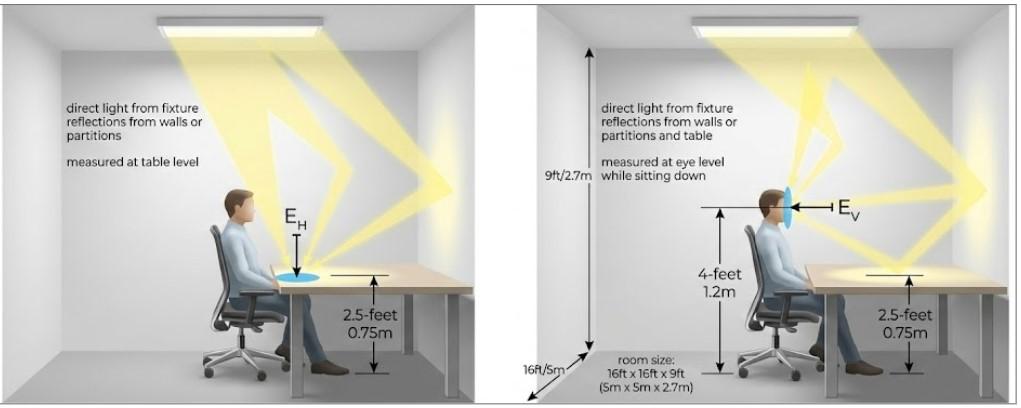
WELL v2 measures EML at the vertical plane at eye level (EV) — not horizontal desk-level illuminance (EH). This distinction is critical: a ceiling fixture may produce high illuminance on the desk, but only a fraction reaches the observer's eyes as vertical illuminance. A wall-mounted fixture facing the observer delivers light directly into this measurement plane.[1]
EML Delivery vs. Distance
The wall mount advantage is strongly distance-dependent — vertical illuminance follows an inverse-square law, so performance drops rapidly beyond 4–5 m. The chart below shows estimated EML at the vertical eye plane from a single CS22 at 6,500 K, 100% output:
The trade-off: wall mounting increases UGR because the fixture is directly in the observer's field of view. However, because the EML-per-watt is so much higher, you can dim the fixture substantially (or use a higher CCT) to bring UGR back down while still exceeding ceiling-mount EML levels.
Wall Mount Glare Management
Maximum output to maintain UGR ≤ 22 (WELL v2) at each workstation distance, from the UGR spec help page:
Distance limitation
Wall mount's EML advantage drops off rapidly with distance. Beyond about 5–6 m, ceiling-mounted fixtures with good room reflectances may match or exceed wall-mount performance. Wall installation works best for compact spaces: individual offices, patient rooms, workstation pods, and small classrooms.
Wall mount tips
Within 4 m, a single wall fixture can replace two or more ceiling fixtures for the same WELL tier — the most cost-effective strategy when geometry allows.
- Use circadian scheduling — high output only during the melanopic-demand window (mid-morning)
- Mount above line of sight — each degree above horizontal increases position index, reducing UGR
- Add ambient lighting — indirect/cove lighting raises Lb without adding glare
- Orient workstations — 30–45° azimuth offset roughly doubles the position index
Combining All Three
These strategies are not mutually exclusive — they stack. A project targeting WELL Tier 2 (275 EML) in an open office might:
- Schedule peak CCT to 10,000 K or higher during core hours — for example, only ~212 photopic lux needed for 275 EML vs. ~393 at 3,500 K in our reference layout.
- Add a second fixture per zone and dim both to 50% — in our example, this cuts UGR by 2.4 points with no change in total light.
- Wall-mount in small rooms (offices, patient rooms) where distance is short — fewer fixtures needed for the same EML performance and WELL v2 points.
- Select the largest fixture that fits — CS154 has the lowest UGR at full output (19.0 vs. 21.3 for CS12 in our example).
Room Factors That Affect UGR
All values above assume CIE standard reference conditions. In practice, the room environment significantly affects UGR — sometimes more than the fixture choice itself.
Dark paint is the most common reason for unexpectedly high UGR
Dark walls (reflectance < 20%) can increase UGR by 3–5 points versus the CIE reference room. A bright room (80/70/40 reflectances) can reduce UGR by 2–3 points. Always model dark rooms in lighting software before specifying.
- Background luminance (Lb) is the denominator in the UGR formula. More ambient light = less contrast = less glare. Supplementary indirect/cove lighting is one of the most effective glare reduction tools, especially for wall-mount installations.
- Higher ceilings increase distance and reduce solid angle: typically −1–2 UGR per additional meter of ceiling height.
- Uniform layouts outperform clusters — even spacing maximizes Lb while clustered fixtures leave dark zones that increase contrast.
- Daylight raises Lb during the day (good) but reverses at night when windows become dark voids (bad).
Further Reading
- Circadian Sky UGR Technical Reference — full UGR calculations, wall-mount geometry, and multi-fixture analysis.
- Melanopic Lighting & Circadian Rhythms — EML, M/P ratios, and the WELL Building Standard.
- Why You Need High-Melanopic Light During the Day — the science behind daytime blue-enriched light exposure.
References
- WELL Building Standard v2, Feature L03: Circadian Lighting Design. Requires ≥ 150 EML (Tier 1) or ≥ 275 EML (Tier 2) measured at vertical eye level. UGR ≤ 22 for general areas.
- CIE 117:1995 — Discomfort Glare in Interior Lighting. Unified Glare Rating formula: UGR = 8×log10[0.25/Lb × Σ(Li²ωi/pi²)].
- CIE S 026/E:2018 — CIE System for Metrology of Optical Radiation for ipRGC-Influenced Responses to Light. Defines the melanopic spectral sensitivity function and M/P ratio calculation.
- EN 12464-1:2021 — Light and lighting — Lighting of work places — Part 1: Indoor work places. UGR limits by application type (e.g. ≤ 19 for offices).